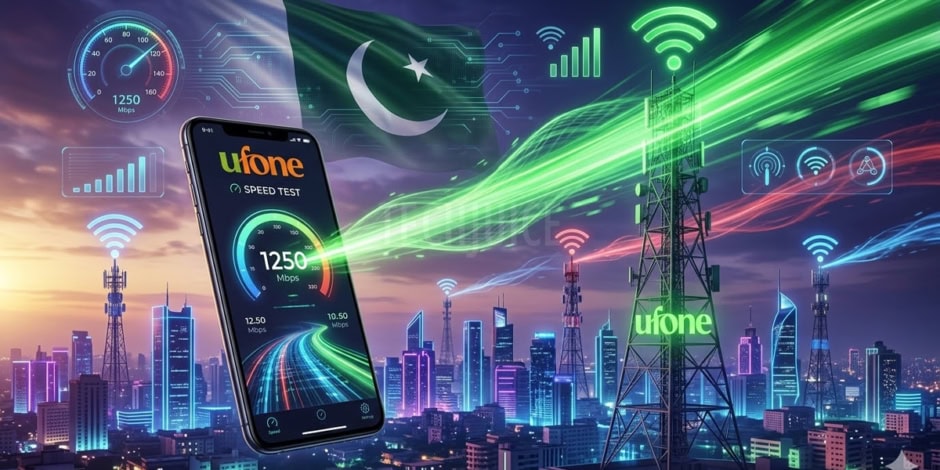
Pakistan’s recently concluded 5G spectrum auction has reshaped the competitive landscape of the country’s telecom sector, with Ufone emerging as the operator holding the largest share of the critical 3500 MHz spectrum band, widely regarded as the backbone of modern 5G networks.
In the auction, Ufone adopted an aggressive acquisition strategy to secure 120 MHz in the 3500 MHz band, more than double the 50 MHz blocks obtained by Jazz and Zong. Holding the largest share enables Ufone to deliver higher speeds, greater network capacity, and improved overall user experience.
With the upcoming integration of Telenor Pakistan into Ufone, the combined entity—‘MergeCo’—is expected to emerge as the operator with the largest overall spectrum, spanning low-, mid-, and high-frequency bands, which will enable the operator to extend 5G services across rural, semi-urban and big cities.
In addition, MergeCo’s 120 MHz contiguous spectrum holding will allow it to deploy wider 5G channels in line with global standards, and enable higher peak speeds, faster sustained data rates, and the ability to support significantly more simultaneous users, especially in dense urban environments where data demand is highest.
This deeper network capacity is expected to translate into enhanced digital experiences for consumers, enabling seamless ultra-high-definition video streaming, immersive cloud gaming, augmented and virtual reality applications, and faster access to an expanding range of digital services and entertainment platforms.
For businesses and enterprises, MergeCo’s high-capacity 5G network will enable a wide range of next-generation industrial and commercial applications. In manufacturing, for instance, it can support smart factories where machines, sensors, and production lines communicate in real time, allowing companies to automate processes, monitor equipment, and improve productivity. In logistics and transportation, connected supply chains and intelligent fleet management systems can use the network to track shipments, optimize routes, and reduce operational delays.
The technology can also enable drone-based inspections, private industrial networks, and immersive virtual communication powered by augmented and virtual reality, allowing engineers and specialists to collaborate and troubleshoot remotely. Combined with AI-powered analytics and reliable cloud connectivity, these capabilities could help businesses run mission-critical operations more efficiently to enhance their productivity. Over time, such connectivity could also support smart city infrastructure, connected mobility systems, and large-scale IoT deployments across multiple industries.
Beyond individual users and businesses, the impact of highest quality next-generation connectivity could extend across key sectors of the economy. In healthcare, education, agriculture, and public services, 5G has the potential to enable innovations such as remote medical diagnostics, virtual classrooms, smart farming technologies, intelligent traffic systems, and next-generation digital financial services.
MergeCo’s large contiguous spectrum block also strengthens its ability to deploy 5G Fixed Wireless Access (FWA), a technology that delivers high-speed broadband without the need for extensive fiber infrastructure. This will allow the operator to scale 5G connectivity more rapidly and extend reliable high-speed internet to its combined user base of more than 70 million Pakistanis.