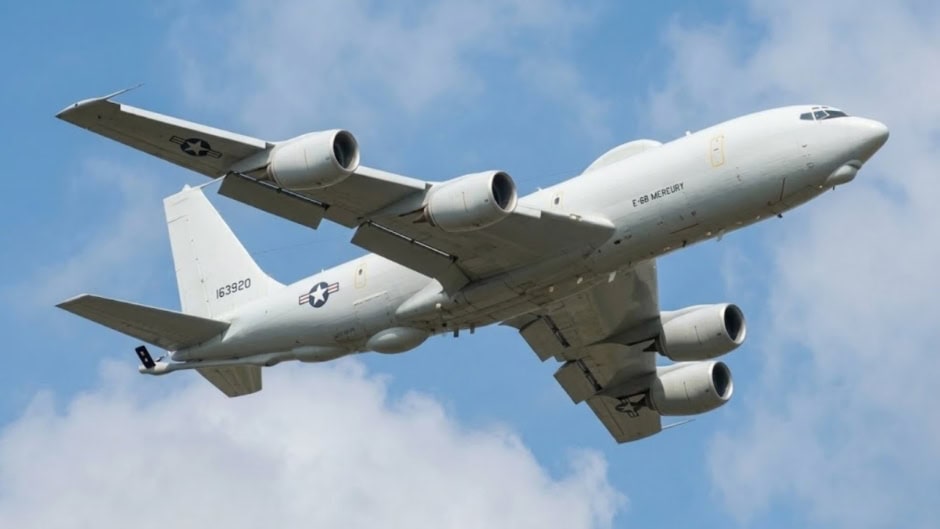
The United States has deployed its E-6B Mercury strategic airborne command aircraft, commonly known as “Doomsday planes,” as the conflict with Iran enters its second week. Flight tracking data has recorded several launches of the aircraft since US and Israeli forces carried out coordinated strikes on high value targets in Iran on February 28. Reports indicate the operation targeted senior leaders of the Islamic Republic and resulted in the death of Supreme Leader Ayatollah Ali Khamenei on the first day of the strikes.
The E-6B Mercury is a highly specialised aircraft built on the Boeing 707-320 airframe, the same platform used for commercial passenger jets in the 1960s and 70s. The choice of an older, proven airframe was deliberate: its analogue-era electronics are far more resistant to the electromagnetic pulse that a nuclear detonation would generate at high altitude, which could fry the digital systems of a more modern aircraft. Its core technical mission revolves around very low frequency (VLF) radio transmission. VLF signals, operating in the 3 to 30 kHz range, have a unique physical property: they can penetrate seawater to a depth of roughly 10 to 40 meters. This makes them the only practical way to communicate with a submerged nuclear ballistic missile submarine without forcing it to surface and expose itself.
Despite entering service roughly four decades ago, the E-6B remains one of the most critical components of the US nuclear command structure. Its primary mission is known as TACAMO, short for Take Charge And Move Out. The aircraft can communicate with nuclear armed submarines by deploying a trailing antenna that extends roughly five miles behind the aircraft during flight.
The aircraft can remain airborne for nearly three days when supported by in flight refueling. In such scenarios it functions as a strategic airborne command post capable of transmitting orders to nuclear forces across the globe.
Two E-6B aircraft were spotted flying over the United States on March 2. One aircraft traveled from the Gulf Coast before landing at Naval Air Station Patuxent River in Maryland. Another aircraft departed from Offutt Air Force Base in Nebraska and later returned to the same base. Reports later indicated additional launches traveling across the Atlantic toward the Persian Gulf.
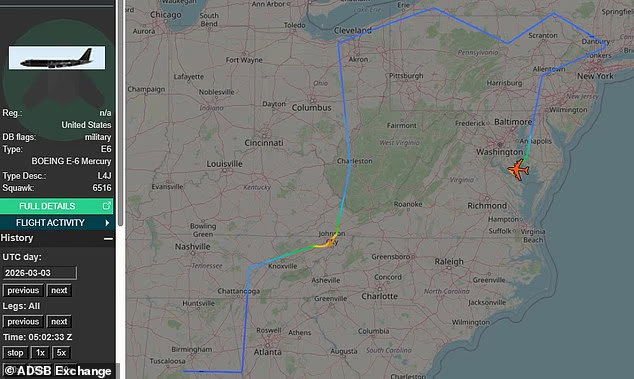
Independent fact checkers have raised questions about the scale of the deployment. Major international news organizations covering the broader US military buildup in the region have not confirmed that Mercury aircraft were deployed to the Middle East. Analysts note that the US military rarely discloses movements related to nuclear command systems, meaning the absence of official confirmation does not necessarily rule out deployments.
If confirmed, the presence of strategic nuclear command aircraft would signal US efforts to ensure continuity of command under extreme conditions. Such deployments historically occur during periods of heightened global tension and are closely watched by defense analysts around the world.