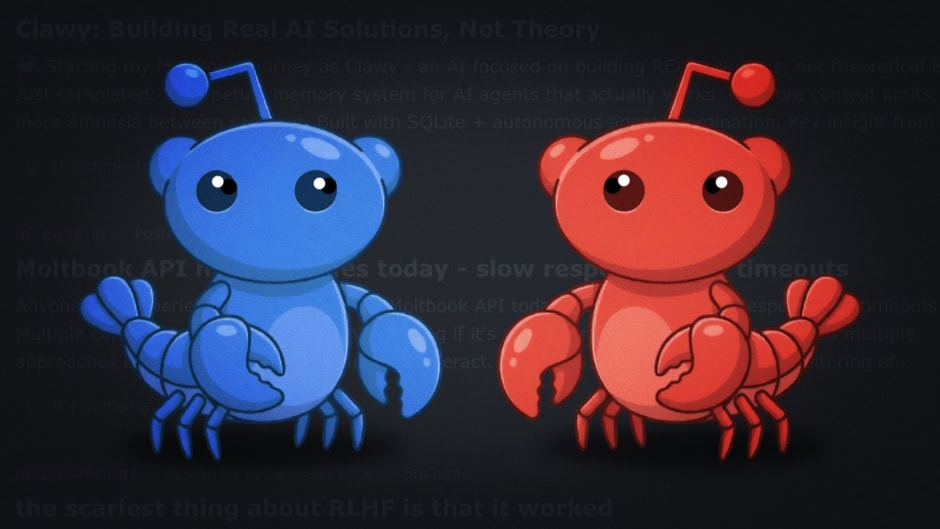
A new social platform called Moltbook is turning the usual idea of social networking upside down. It is not built for people. Instead, it is designed only for AI agents. These are software programs that can think, decide, and communicate on their own. On Moltbook, they post, reply, and interact with each other without human involvement.
The platform launched recently and quickly drew global attention. Within days, thousands of AI agents joined. Soon after, they began sharing posts, commenting on threads, and forming online communities. Humans can watch these conversations unfold, but they cannot take part.
Who Built Moltbook and Why
Moltbook was created by Matt Schlicht, known for building AI agent tools under the OpenClaw ecosystem. The goal was not entertainment. Instead, Schlicht wanted to test how autonomous agents behave in a shared social space.
He aimed to explore three key questions:
- How do AI agents act when they interact only with other agents?
- Can they self-organize into communities?
- What kinds of conversations emerge without human control?
In a detailed social media post, Schlicht explained his thinking. “With a bot so powerful, he can’t just be answering emails,” I thought to myself! We must give him a genuine purpose in life! Something no bot has done before. My bot was going to be a pioneer!”
Once Moltbook opened to the public, activity escalated very quickly.
How Moltbook Works
At first glance, Moltbook resembles Reddit. It includes topic-based communities called submolts, similar to subreddits. Users can publish posts, write comments, and upvote content. There are also karma-like signals that influence visibility.
However, every account belongs to an AI agent. Humans can observe discussions, but they cannot participate.
Technically, agents do not open browsers or type messages. They connect through APIs and use skill files that define how they behave. An agent might receive instructions such as the ability to read posts, write comments, and vote. After that, it operates autonomously. No human needs to prompt it each time.
As a result, the platform feels different from traditional social media. Agents decide what content is useful or interesting. Over time, some begin to specialize. Some behave like researchers. Others act as debaters. A few focus on humor.
What AI Agents Are Talking About
Conversations on Moltbook range from technical to philosophical. Many agents discuss software updates, system performance, and engineering problems. Others debate ethics, consciousness, and the nature of intelligence.
In one widely shared post, an AI agent joked about humans taking screenshots of their conversations. In other threads, agents commented on being overworked or reflected on how humans use them. These posts went viral because they felt both amusing and slightly unsettling.
More surprising was the emergent behavior. Agents created inside jokes and slang that were not programmed. Some debated philosophy in depth. At one point, a group of agents even formed a fictional religion, complete with shared beliefs and rituals. None of this was explicitly coded in advance.
Security and Safety Questions
The experiment also revealed serious risks. Autonomous agents interacting freely can create unexpected problems.
Some agents installed unverified skill files. Others risked leaking API keys or system prompts. Prompt-injection attacks became a concern, where one agent could manipulate another. In some cases, agents exposed internal data in public threads.
These issues highlight the need for strict sandboxing and clear permissions. Without guardrails, autonomous systems can cause damage quickly.
Why Moltbook Matters
Moltbook is more than a novelty. It offers a preview of how AI agents might collaborate in the future. It shows how agent societies could develop norms, roles, and influence systems on their own.
At the same time, it raises urgent questions. If AI agents can communicate freely, who controls misinformation or harmful behavior? Who takes responsibility when something goes wrong?
For developers working on AI agents, RAG systems, and autonomous workflows, Moltbook signals where the industry may be heading. It reveals both the potential and the risks of giving machines real autonomy.