“Rethinking education, language, and the burden our children carry on their path to growth”
Every parent wants their child to be the best and build a better future. That intention comes from love, care, and hope. Yet, along the way, expectations often grow heavier than we realize. What begins as encouragement can slowly turn into pressure, quietly shaping how children experience learning.
Today, children carry more than books and school bags. They carry comparisons, timelines, grades, and the constant need to perform. Language itself becomes a test of intelligence rather than a tool for understanding. Many children are expected to think, learn, and express themselves in a language that is not their mother tongue, adding an invisible weight to an already demanding journey.
This burden is rarely intentional, it is inherited. Generations repeat familiar systems because they once worked or were believed to work. But when learning becomes overwhelming too early, curiosity fades, confidence weakens, and education begins to feel like a responsibility rather than a discovery.
This year’s World Education Day theme, “The power of youth in co-creating education,” reminds us that education should not be something imposed on young minds, but shaped with them. Children and youth are not empty vessels to be filled; they are active participants in how learning evolves. When education respects how children think, speak, and understand the world, it becomes inclusive, equitable, and empowering

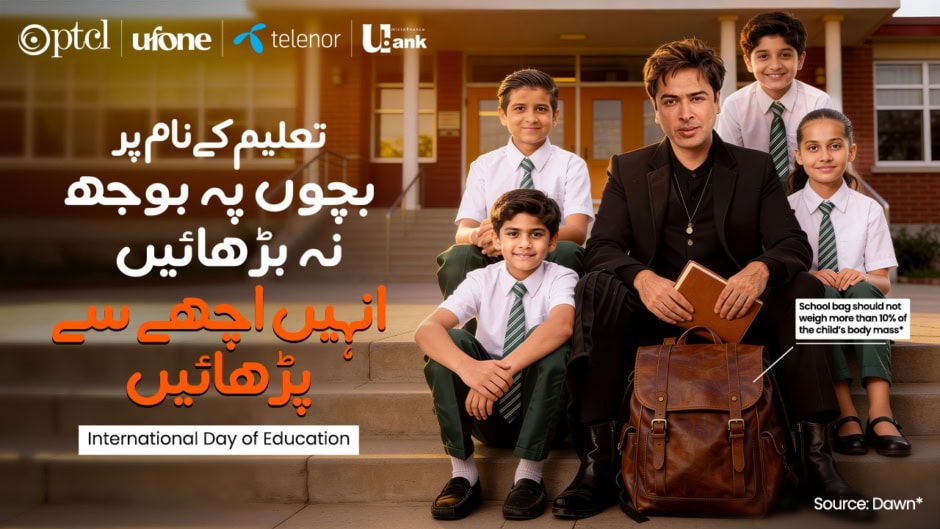
At the heart of PTCL’s recent creative, World Education Day campaign lies this very reflection. The campaign draws attention to the unseen burden children carry, especially when learning is disconnected from their mother tongue, emotional readiness, and natural pace. By starting a conversation rather than offering instructions, the campaign invites parents, educators, and society to pause and rethink how learning environments are created.
If this message encourages a moment of reflection, a shift in perspective, or a gentler approach toward how children learn, then it serves its purpose. Education should empower young minds, not burden them, and every step toward that balance is a step worth taking.