When Pakistan’s three mobile operators lined up for the 5G spectrum auction earlier this month, the question was not whether Zong would participate. It was how aggressively.
The answer came on March 19, when the China Mobile subsidiary became one of the first two operators to commercially switch on 5G, launching across more than 16 cities in a single day. That number has since grown to 17.
No other Pakistani operator matched that geographic spread on day one. Jazz, which launched the same day, went live in eight cities. Ufone has not launched at all yet.
Read More: Here’s the Complete List of Zong 5G Compatible Phones in Pakistan 2026
Zong’s 5G network currently covers:
- Islamabad
- Rawalpindi
- Lahore
- Karachi
- Peshawar
- Quetta
- Faisalabad
- Multan
- Sialkot
- Gujranwala
- Hyderabad
- Attock
- Jhelum
- Abbottabad
- Mardan
- Kohat
- Swabi
Coverage in all cities remains concentrated in select areas rather than spanning entire metropolitan boundaries. Zong’s interactive coverage map allows users to select their city and check whether their specific area has an active signal.
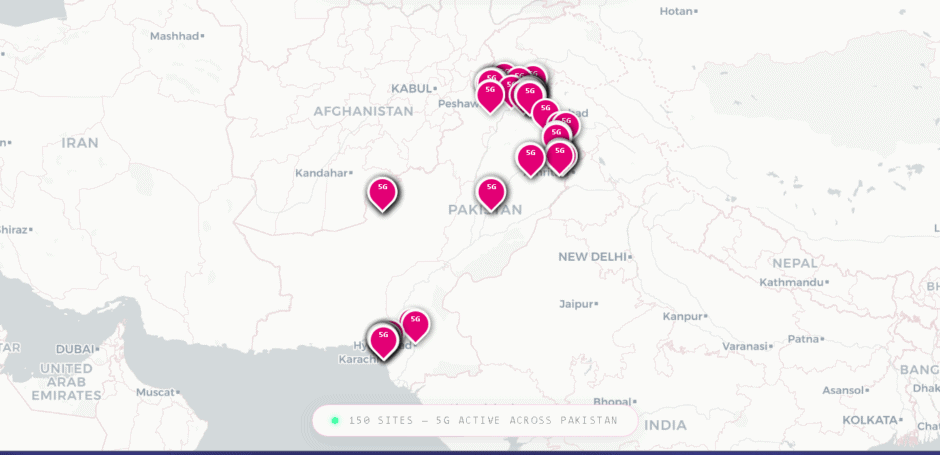
The company’s 5G journey dates back to 2019, when it conducted Pakistan’s first 5G trial and demonstrated speeds exceeding 1.4 Gbps. As a subsidiary of China Mobile Limited, the world’s largest telecom operator, Zong has access to global infrastructure expertise and supply chains that smaller operators cannot easily replicate. The company has committed to deploying and upgrading over 1,000 5G sites across Pakistan by the end of 2026.
Commercial 5G speeds, however, are considerably more modest than trial figures. Initial speeds have been set at 50 Mbps, which is still 2.5 times faster than the current 4G cap of 20 Mbps introduced after the spectrum auction. Real-world performance will depend on congestion, proximity to towers, and device compatibility.
Zong’s early lead in geographic reach gives it a visibility advantage in a market where perception matters. Whether that translates into a subscriber advantage will depend on how quickly the network densifies within these 21 cities and how soon Apple and Samsung remove the device bottleneck that is keeping most potential 5G users on the sidelines.