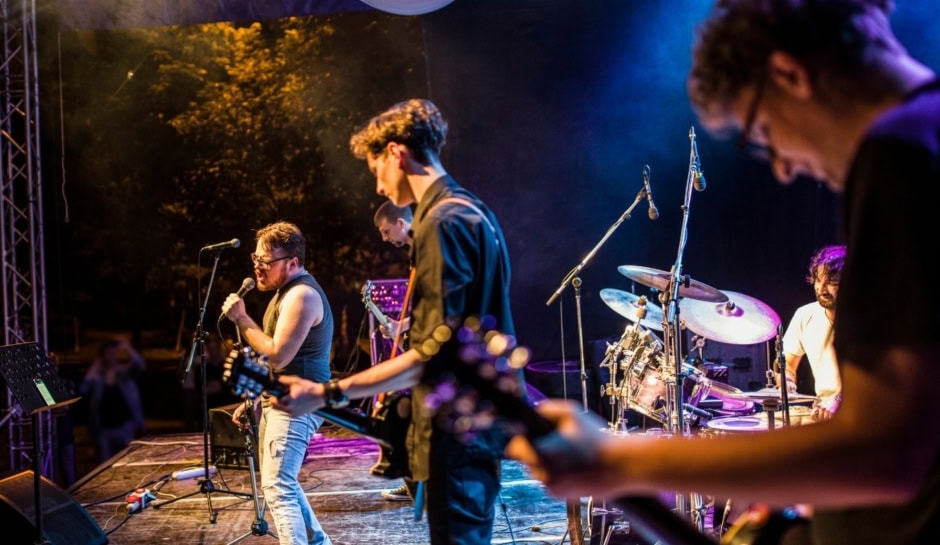
Psychedelic rock band The Velvet Sundown boasts over 1 million monthly listeners on Spotify and thousands of dollars in streaming revenue, yet it’s not a real band in the traditional sense.
Instead, it’s a “synthetic music project guided by human creative direction, and composed, voiced, and visualized with the support of artificial intelligence,” according to its updated Spotify bio.
Described as an “artistic provocation,” the project is designed to question boundaries around “authorship, identity, and the future of music itself in the age of AI.”
But its slick visuals, suspiciously generic song titles like “Dust on the Wind,” and absence of live performance clues led many to suspect its AI origins long before it was confirmed.
From Experiment to Income Stream
AI platforms like Suno and Udio make it easy to create full songs using simple prompts. Anyone with internet access can now generate music that sounds almost human-made.
The Velvet Sundown is a virtual band. Yet, it reportedly earned about $34,235 in one month across streaming platforms, according to ChartMasters’ estimates.
And it’s not alone. Other AI-driven acts like Aventhis, a “dark country” project, are quietly climbing the charts, with hundreds of thousands of monthly Spotify listeners.
Not everyone is impressed. In interviews with CNBC, music professionals called the trend “soulless,” “stifling,” and even “creepy.” While AI has been part of music production for years, via tools integrated into software like Logic, the ability to create complete compositions has raised ethical and creative red flags.
Jason Palamara is a music technology professor at the Herron School of Art and Design.
He says The Velvet Sundown is “much better music than most of what we’ve heard from AI in the past.”
He points out its clear structure and lyrical flow.
But he also warns this is just the “tip of the iceberg.” Platforms like Suno and Udio make it easy and cheap to produce large amounts of music.
AI Tracks Flooding Streaming Services
Deezer, the French music-streaming company, reported that 18% of all new tracks uploaded to its platform are now fully AI-generated. This has sparked significant concern among music labels and independent artists.
Major record labels, including Sony Music, Universal Music Group, and Warner Records, have already filed lawsuits against Suno and Udio. They accuse the platforms of widespread copyright infringement. In addition, artists and creators have called for AI systems to stop training on human-created art without permission.
For rising musicians like Tilly Louise, a U.K.-based alternative pop artist, AI music’s viral success feels like a gut punch. Despite her millions of streams, she says she’s never made enough from streaming to quit her full-time job.
“For a band that doesn’t even really exist to then get all that social media traction, it’s so discouraging,” Louise said.
Some institutions are already responding. Music professors say they’re integrating AI into their curriculum, not to replace creativity, but to teach students how to use it as a production tool.
Meanwhile, Grammy-winning producer Timbaland has embraced the trend, launching Stage Zero, an entertainment venture featuring AI-generated pop stars.
But even advocates admit the future is uncertain. “It will create a completely different model of the music industry that we can’t predict yet,” said Palamara.
A Growing Demand for Transparency and Regulation
Critics argue the rapid rise of AI music risks overwhelming human creativity.
Anthony Fantano, a well-known YouTube music critic, warned, “[M]usic fans should be worried because the proliferation of AI music and content clogs our social media feeds and algorithms, making it difficult for us to connect with one another.”
He added that AI music is simply a tool for “greedy capitalists” to sideline real artists.
In response, industry figures are pushing for clear labeling of AI-generated music and stronger copyright protections. Spotify has yet to comment on its policy around identifying or labeling AI-created tracks.
Tino Gagliardi, president of the American Federation of Musicians of the United States and Canada, issued a call to action: “Consent, credit, and compensation are prerequisites in AI development. And transparency, including in streaming and other marketplaces, is the foundation for safeguarding musicians’ livelihoods. Anything short of that is theft.”
While AI continues to reshape the music world, the debate over authenticity, creativity, and fair compensation grows louder. For now, The Velvet Sundown may be artificial, but the questions it raises for the industry are very real.