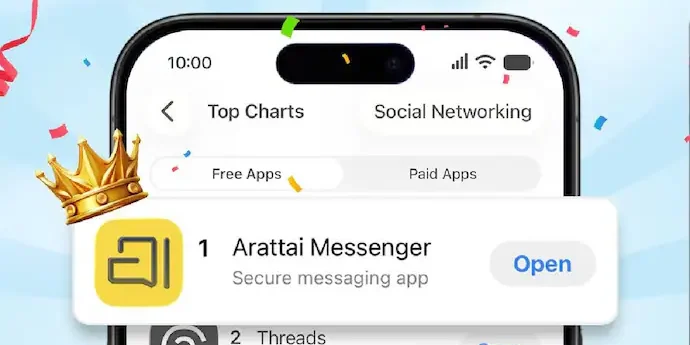
Arattai, the India-made messaging app developed by Zoho Corporation, is experiencing an unprecedented spike in growth. In the past few days, the platform has seen a 100x increase in daily sign-ups, jumping from around 3,000 users a day to more than 350,000 new registrations. Talk about Spreading like a Wildfire. The sudden spike has prompted Zoho to rapidly scale its infrastructure in an attempt to keep up with demand.
The word Arattai literally means “chat” in Tamil. First launched in early 2021, the Arattai app has recently gained renewed traction after recognition from Indian government officials started coming in. Union Education Minister Dharmendra Pradhan urged citizens to embrace indigenous digital tools, describing Arattai as a:
“Secure, Indian alternative to WhatsApp.”
The endorsement quickly pushed the app into the top charts of the Apple App Store in India.
Features and Challenges
The Arattai app offers everything that any mainstream messaging platform offers, including text chats, audio and video calls, media sharing, stories, and voice notes. According to Zoho’s founder, Sridhar Vembu, voice and video calls are already end-to-end encrypted, while chat encryption is still under development.
However, scaling challenges also flooded in with the sudden spike. Users have reported a wide range of problems, from OTP verification delays and syncing errors to occasional server issues. Vembu admitted the backend strain but assured users that the team is preparing for another wave of growth. Vembu said,
“We had planned for a major release later this year with a capacity upgrade and a marketing push… But growth went vertical overnight. Please give us some time… we have a lot more planned for Arattai.”
A Broader Trend: Local Alternatives to Global Giants
The Arattai app’s resurgence is being perceived as an important part of a larger movement worldwide, where nations are investing in homegrown apps to reduce reliance on foreign tech giants.
China has long promoted WeChat as its all-in-one platform, tightly integrated with payments, social media, and government services.
Russia backs VKontakte (VK) and Telegram, both widely adopted as alternatives to Western platforms.
Turkey attempted to promote its BiP messenger, developed by Turkcell, as a national alternative to WhatsApp.
These efforts often come integrated with the idea of reforming data privacy and revitalizing digital sovereignty, much like India’s “Atmanirbhar Bharat” (self-reliant India) sentiment that is fueling the Arattai app’s popularity.
Has Pakistan Tried Something Similar?
Attempts at creating indigenous messaging apps have been limited and less impactful in Pakistan. Some smaller local startups and government-backed initiatives have floated messaging platforms, but none have managed to reach mainstream adoption. They didn’t even come close to challenging WhatsApp’s dominance. Pakistan has largely relied on foreign apps like WhatsApp, Facebook Messenger, and Telegram… and it still does with no serious large-scale “Made in Pakistan” alternatives in sight.
The Road Ahead
Despite its explosive rise, the Arattai app faces an uphill battle against WhatsApp, which benefits from deep network effects, robust infrastructure, and global adoption. Zoho will need to deliver on encryption, reliability, and user experience while leveraging its broader SaaS ecosystem to build stickiness if it really wants to retain long-term users.
For now, the Arattai app’s growth story reflects not only India’s ambition for self-reliance regarding tech but also a growing global trend where nations seek to reclaim digital sovereignty from foreign platforms. Whether the app’s momentum translates into a permanent shift or fades as another short-lived experiment… will depend on how well Zoho manages to scale and keeps users engaged.