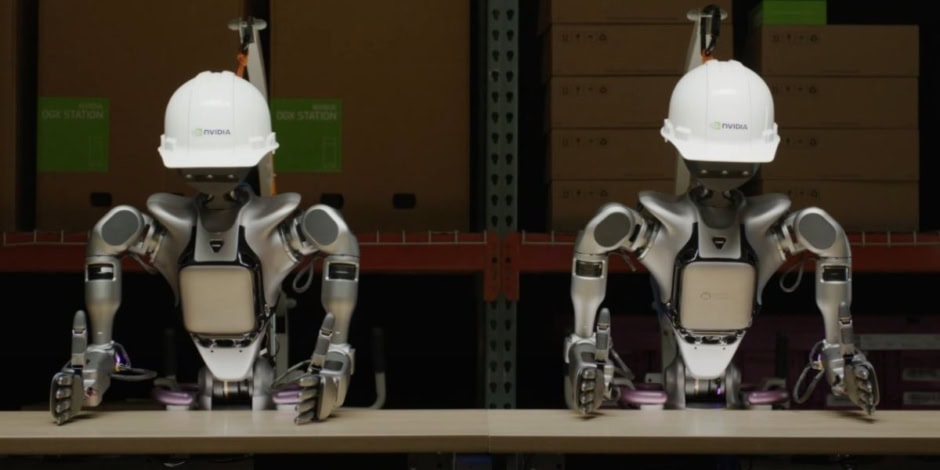
NVIDIA has introduced a sweeping robotics stack aimed at accelerating the development of humanoid robots, robots that can move and reason safely in unpredictable, real world environments.
At the heart of the announcement are three components: the open source Newton Physics Engine, the new robot “brain” model Isaac GR00T N1.6, and the expanded AI infrastructure integrated into the Isaac Lab platform. These together deliver what NVIDIA calls a unified, accelerated robotics stack.
Newton Engine: Simulating Real World Physics
The beta version of the Newton Engine is now available open source. It is GPU accelerated and managed under the Linux Foundation. Built using NVIDIA’s Warp and OpenUSD frameworks with contributions from Google DeepMind and Disney Research, Newton offers flexible solver systems capable of handling complex real world conditions: walking on gravel or snow, manipulating fragile objects, or moving through uneven terrain. Early adopters include robotics labs and universities such as ETH Zurich, Technical University of Munich, and Peking University.
One key advantage is that robots trained in simulation using Newton can transfer learned skills more reliably into real environments, a major bottleneck in humanoid robotics so far.
Isaac GR00T N1.6 Robot: Reasoning & Perception Mix
Alongside Newton, NVIDIA introduced Isaac GR00T N1.6, a robot foundation model that includes a reasoning vision language component dubbed Cosmos Reason, designed specifically for physical AI. This “brain” model helps humanoids interpret vague instructions, generalize across new tasks, and handle perception and decision making in more human like ways.
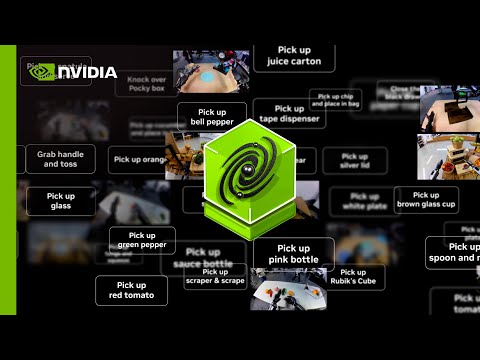
Developers can fine tune GR00T using NVIDIA’s Physical AI Dataset on Hugging Face, which includes millions of synthetic and real world motion trajectories. Version N1.6 also improves joint manipulation capabilities, such as holding heavy doors, grasping delicate items, and coordinating movement with object interaction.
Infrastructure & Deployment on Robot Intelligence
To support real time robot intelligence, NVIDIA has built out its AI infrastructure with powerful hardware like GB200 NVL72 systems, RTX PRO Servers, and Jetson Thor modules. These are meant to let robots not just simulate, but perform inference, and adapt on device rather than relying solely on cloud computing.
Additionally, NVIDIA released Cosmos World Foundation Models for creating synthetic data, and an open framework called Isaac Lab Arena for scalable evaluation of robot skills in test environments.
Humanoid robots are among the most complicated AI systems to build because they require integrated control of muscles, physics, perception, and decision logic. By combining Newton’s simulation accuracy, GR00T’s reasoning, and robust infrastructure, NVIDIA is trying to close the gap between research prototypes and robots that can safely operate in homes, workplaces, or unpredictable outdoor settings.