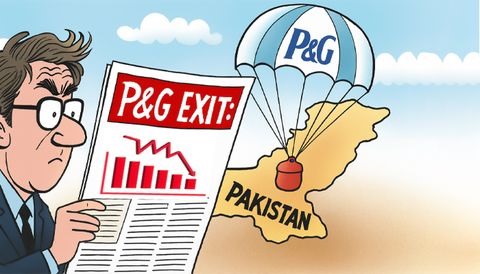
When Procter & Gamble announced its exit from Pakistan, the news cycle did what it often does: amplified, sensationalized, and unfortunately, weaponized. Some voices framed it as evidence that Pakistan is becoming “uninvestable.” But reality, backed by Hard data and global precedent, tells a different story.
Exits Happen Everywhere
Corporate exits are neither new nor uniquely Pakistani. Globally, we’ve seen household names retreat from markets for reasons that have little to do with the host country’s viability.
- Walmart exited Germany and South Korea despite their robust economies. creating space for local champions like Aldi and E-Mart to rise.
- Uber sold its operations in China and Southeast Asia, not because those markets lacked promise, but because regional players like Didi and Grab outcompeted it.
- Telenor exited nine markets over the last seven years, including strong economies, as part of global portfolio reshuffling.
Exits often mark strategic repositioning rather than systemic rejection. They free space for local players to grow and, in many cases, become the next regional or global names.
Pakistan: Not Exodus, but Evolution
The perception of a mass foreign investor flight is contradicted by facts:
- FDI inflows grew 17% year-on-year in FY24, reaching $1.9 billion.
- 16 new foreign firms entered or expanded in Pakistan in the last 18 months, replacing or acquiring assets from those who left.
- Key sectors are actively attracting capital: $800m in power, $304m in oil & gas, growing interest in IT parks, renewable energy, and pharmaceuticals.
Even within consumer goods, local champions are stepping in. P&G’s Safeguard soap business has been acquired by Nimir Industrial Chemicals, while Lucky Core Industries and OBS Pakistan have taken over assets from Pfizer and Bayer. These are precisely the kinds of transactions that build homegrown resilience.
Strategic Confidence: The Saudi Aramco Example
If Pakistan were truly “uninvestable,” global giants wouldn’t be writing billion-dollar cheques. Yet, in May 2024, Saudi Aramco invested $200 million to acquire a 40% stake in Gas & Oil Pakistan Ltd. Likewise, Wafi Energy, Gunvor Group, and other international players are stepping into spaces vacated by Shell and Total.
Why Narratives Matter
Ordinary business decisions, like a multinational divesting one product line, get spun by anti-state actors into tales of decline. This is narrative warfare as much as economics. As policymakers, corporate leaders, and informed citizens, we must separate noise from signal.
The signal is this: Pakistan’s market of 241 million (estimated) people is young, growing, and hungry for goods, services, and innovation. Multinationals may shuffle portfolios, but the demand doesn’t leave with them. Someone must step in to serve it, and increasingly, that “someone” is Pakistani enterprises ready to scale.
From Consumer to Producer Economy
Exits should also nudge us toward a strategic rethink. For too long, Pakistan has been viewed primarily as a consumer market for global brands. Each divestment is also an invitation for local players to:
- Acquire global assets, gaining IP and brand equity.
- Scale in adjacent markets, as Turkey’s Coca-Cola İçecek did after consolidating in Pakistan.
- Build resilience, reducing dependence on import-heavy models.
This is how countries graduate from being passive consumption zones to active production hubs.
Closing Thought
P&G’s exit is a headline, not a harbinger. The real story is in the acquisitions, investments, and expansions filling the space they leave behind. The question for us is not whether foreign firms will stay forever; it’s how Pakistan can turn every divestment into a launchpad for its own champions to rise. And that story is far bigger than any single multinational.