The Punjab government has announced a series of emergency measures aimed at reducing fuel consumption and managing economic pressure caused by the ongoing regional conflict. The decisions include suspending official fuel for provincial ministers, cutting vehicle fuel allowances for government officers and shifting many public offices to work-from-home arrangements.
The steps were announced after a meeting chaired by Punjab Chief Minister Maryam Nawaz in Lahore, where officials reviewed the situation arising from the petroleum shortage and its possible economic impact on the province.
Under the new policy, fuel provided for provincial ministers’ official use has been suspended until the crisis eases. In addition, petrol and diesel allowances for government officers’ vehicles have been reduced by 50 percent with immediate effect.
The government has also imposed restrictions on protocol vehicles that usually accompany ministers and senior officials. Only one vehicle will now be allowed with them for essential security purposes, a move officials say is meant to cut unnecessary fuel consumption.
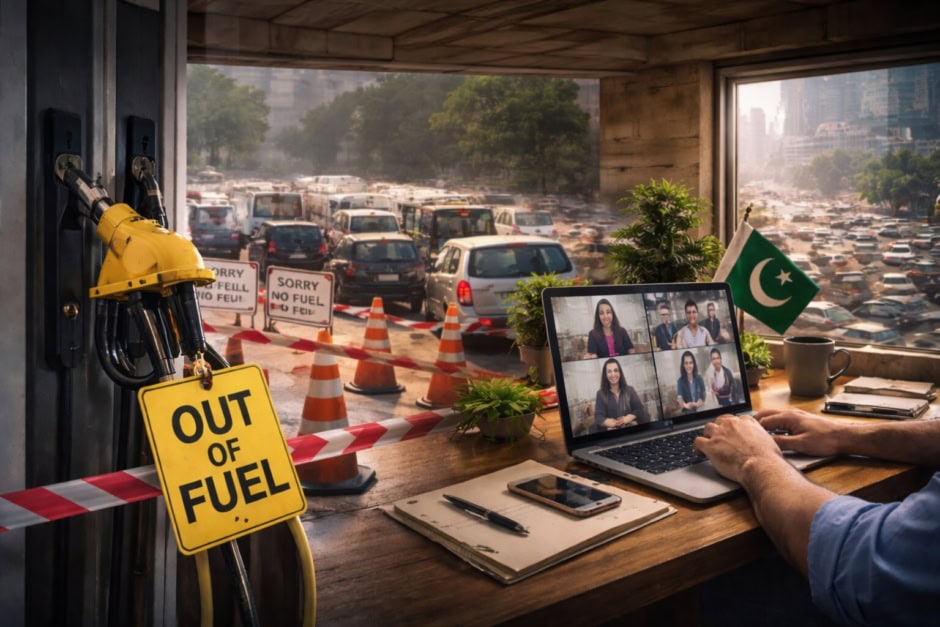
Another major decision is the introduction of work-from-home arrangements in government departments. Authorities clarified that only essential staff will be required to attend offices while the rest of the work will continue remotely to reduce daily commuting and fuel usage.
The education sector will also see temporary changes. Schools, colleges and universities across Punjab will remain closed from March 10 to March 31.
However, examinations will continue according to their scheduled dates. Educational institutions have been allowed to conduct online classes during this period so that academic activities are not completely disrupted.
The government has additionally imposed a ban on official outdoor events. The annual Horse and Cattle Show, one of the province’s well-known cultural festivals, has also been postponed as part of the austerity measures.
Most official meetings will also be held online through teleconferencing instead of in-person gatherings. She also paid tribute to Prime Minister Shehbaz Sharif and Field Marshal Asim Munir for what she described as courageous decisions during the difficult situation, warning that those trying to exploit the crisis would face strict action.
To ensure fuel supplies are monitored closely, the chief minister has directed the creation of petroleum monitoring committees in every district. The Punjab Information Technology Board has been tasked with developing a digital track-and-trace system to monitor petroleum products and prevent misuse or illegal distribution.
District administrations have also been instructed to keep a strict check on transport fares and take action against anyone charging excessive rates. Authorities will simultaneously monitor the supply and demand of essential food items across the province to avoid shortages or artificial price hikes.
In her message to the public, Maryam Nawaz urged citizens to cooperate with the government during what she described as a difficult period. She appealed to people to avoid unnecessary outdoor events, late-night shopping and hoarding of essential goods.