
An open-source AI project called MiroFish has been gaining rapid traction on GitHub, offering a fundamentally different approach to forecasting by simulating collective human behavior rather than crunching historical statistics.
Reportedly built by a young Chinese programmer and backed by Shanda Group founder Chen Tianqiao, MiroFish is a swarm-intelligence engine that populates a virtual environment with thousands of independent AI agents. Each agent is given its own behavioral profile, memory, and decision-making logic.
As a simulation progresses, the agents communicate with one another, react to incoming information, and influence each other’s choices, producing emergent patterns that mimic how real groups of people respond to events.
The system begins by ingesting real-world data from news articles, financial reports, policy documents, or social media conversations. This information is organized into a structured knowledge graph using GraphRAG, a retrieval technique that maps connections between people, institutions, and events rather than treating documents as isolated text blocks. The knowledge graph forms the foundation of the simulated environment in which agents operate.
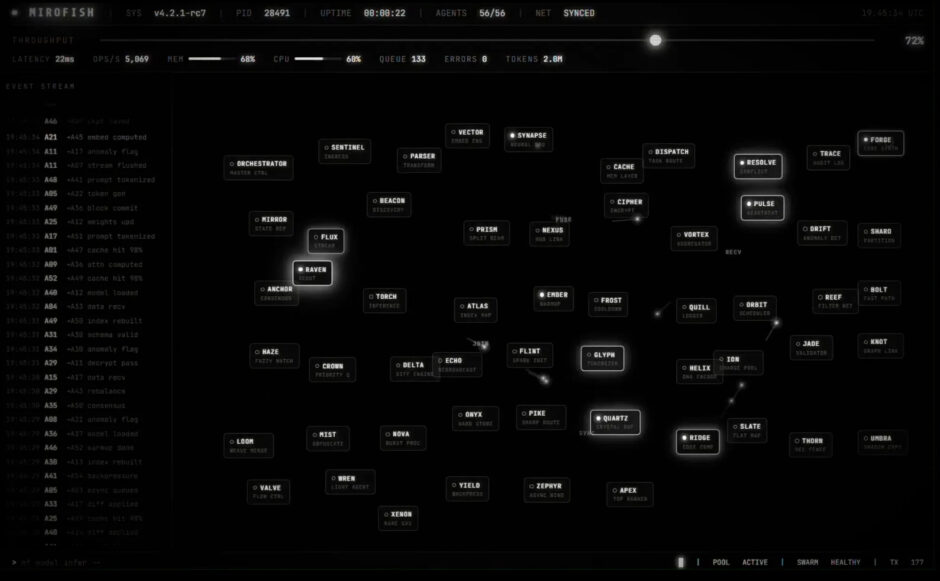
On the technical side, MiroFish runs on a Python-based backend that manages the simulation, paired with a Vue.js visual interface where users can observe agent interactions in real time. The platform uses the Zep memory system to give agents long-term recall, allowing them to store and retrieve experiences across multiple simulation rounds. This means agent behaviors can evolve over time rather than resetting with each run. The engine can be deployed locally or through container systems like Docker and supports integration with large language models compatible with the OpenAI API framework.
The practical applications span a wide range. Users can model market sentiment, simulate public opinion shifts, test how populations might respond to policy changes, or explore narrative outcomes in creative contexts. MiroFish also generates interactive analytical reports based on agent behavior, letting users adjust parameters and observe how the virtual environment reacts to different scenarios.
Supporters say the approach offers something traditional forecasting models cannot: a way to model the messy, interconnected dynamics of social behavior rather than relying on purely statistical predictions.
However, the researchers behind MiroFish stress that it is designed for scenario exploration, not precise forecasting. The distinction matters. The tool helps users understand the range of possible outcomes and the dynamics that drive them, rather than offering a single confident prediction.