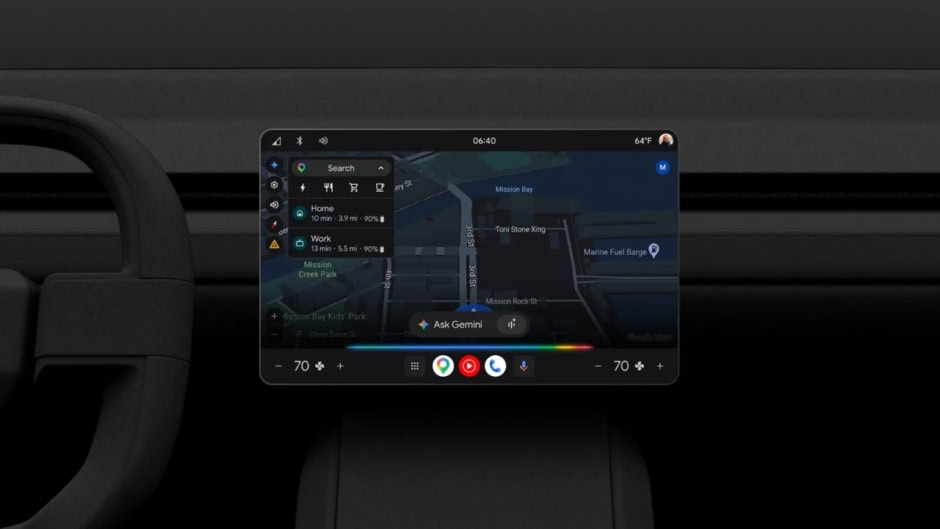
Google began rolling out Gemini artificial intelligence to replace Google Assistant in vehicles running Android Automotive operating system marketed as Google built-in, bringing more natural conversational capabilities and vehicle-specific intelligence to approximately 4 million cars in the United States through over-the-air software updates announced April 30, 2026. The upgrade transforms in-car voice interaction from rigid command-based Google Assistant requiring precise phrasing into fluid multi-turn conversations where drivers can ask follow-up questions, ramble naturally and interrupt mid-response the way real human dialogue actually works.
The rollout targets both new vehicles shipping with Google built-in and existing cars from model year 2020 onward including approximately 4 million General Motors vehicles spanning Buick, Cadillac, Chevrolet and GMC brands from 2022 and newer according to GM’s announcement. Eligible users signed into Google Accounts in their cars will see prompts to upgrade to Gemini over coming months, with the option to stick with Google Assistant temporarily though Google has not specified how long that choice will remain available as the company pushes toward full Gemini adoption across its product ecosystem.
Gemini appears in car infotainment systems with a multicolored light bar and an “Ask Gemini” pill above it, accessed by saying “Hey Google,” tapping the microphone on the home screen or using steering wheel buttons. The biggest improvement according to Google is conversational naturalness allowing drivers to speak freely rather than memorizing specific voice commands that Google Assistant demanded, with Gemini understanding context across multiple exchanges so users can ask follow-up questions without restating entire queries from scratch.
The integration goes deeper than simple voice recognition by connecting Gemini directly to manufacturer-provided owner’s manuals enabling vehicle-specific responses tailored to exact car models. Drivers can ask questions like “How should I prepare my car for an automatic car wash” or “My garage ceiling is low and the trunk is hitting it, how do I program the trunk so it doesn’t open all the way” and receive accurate model-specific answers pulled from official documentation rather than generic internet search results that may not apply to their specific vehicle configuration.
Google worked closely with automakers to integrate Gemini with vehicle control systems allowing natural language commands for climate, lighting and other functions without navigating software menus. Drivers can say “It’s foggy and freezing in here” and Gemini will understand the implied request to turn up heat and activate defrosters, interpreting environmental complaints as actionable instructions rather than requiring explicit system commands. Electric vehicle owners get real-time battery insights through conversational queries like “What’s my current battery level” or “What’s my battery on arrival” without digging through interface menus.
Gemini Live launches in beta within the car environment enabling free-flowing conversations while driving for destination research, activity brainstorming or general knowledge queries. Drivers can ask Gemini to share history and fun facts about upcoming destinations, recommend hiking options in specific regions, or explain complex topics during long drives with the ability to interrupt responses and change direction mid-conversation. The feature aims to make drive time more productive and engaging beyond basic navigation and music control.
The messaging capabilities receive significant upgrades as voice-to-text represents Gemini’s core strength, allowing drivers to send and check messages with greater confidence in transcription accuracy. Navigation benefits from real-time Google Maps integration enabling Gemini to answer contextual questions about traffic disruptions near events, parking availability at destinations and highly-rated restaurants along routes with outdoor seating options, then handle follow-up questions about specific venue features without starting conversations over.
Commercial drivers gain planning assistance through Gemini’s optimization capabilities with example queries like “I have three stops to make today and need to finish my day with at least half a tank, can you help me find the least expensive fuel along my route” or “Where is the best trailer-friendly parking near me” addressing professional driver needs beyond consumer use cases. The differentiated feature set demonstrates Google’s attempt to serve multiple driver segments through a single conversational interface.
Industry observers note the upgrade addresses longstanding frustrations with Google Assistant which many drivers found clunky, requiring precise phrasing and offering no contextual memory between commands. However concerns remain about Gemini’s tendency to hallucinate or confidently state incorrect information, which carries different consequences in automotive environments compared to casual chatbot interactions. A wrong restaurant recommendation causes annoyance but incorrect interpretation of dashboard warning lights or safety features could create dangerous situations, with Google not yet publishing specific guardrails for automotive use cases.
The rollout begins with English language support in the United States expanding to additional languages and countries in coming months, with Google planning to enable Gemini access to information from Gmail, Calendar and Google Home apps allowing deeper integration with drivers’ digital ecosystems. The update represents Google’s broader strategy to position Gemini as the unified conversational interface across all product categories from smartphones to smart home devices and now vehicles.