
Pi Network is about to find out whether its community’s patience has a price tag, and that price tag is 200 million tokens.
The token, which initially surged to $0.2973 on March 13 before pulling back sharply to around $0.1795, now faces its biggest near-term test: approximately 200 million PI tokens are scheduled to unlock throughout April. At current prices, those tokens represent about $34 million in potential selling pressure, equivalent to roughly 2% of the token’s total market capitalization. That may not sound catastrophic on paper, but for a token already trending downward with thin liquidity, it could accelerate the decline.
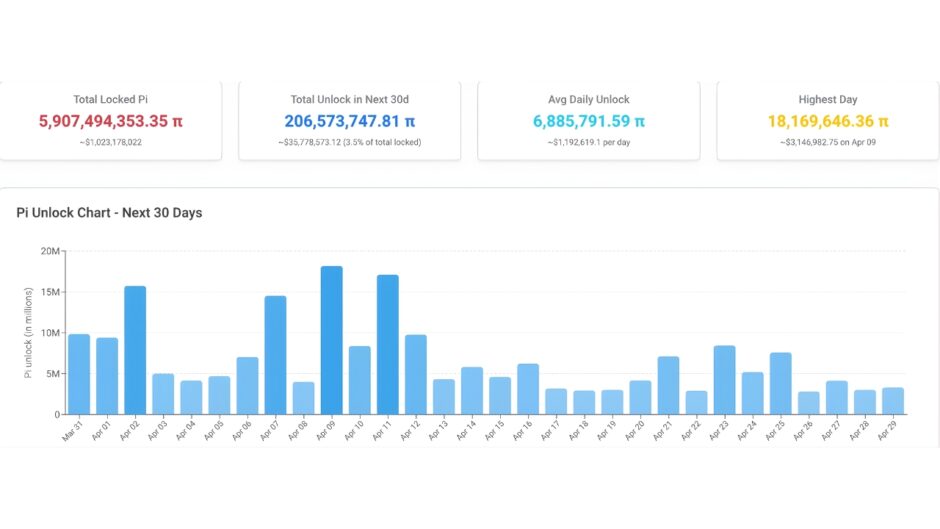
The unlock schedule does not end there. Another 79 million tokens are set to be released in May, followed by 82.4 million in June. Over the next 12 months, Pi Network will unlock more than 1.62 billion tokens worth over $280 million at today’s valuation. The circulating supply currently sits at about 9.9 billion tokens against a total supply of 100 billion, meaning the vast majority of Pi’s token supply is still waiting to enter the market.
Token unlocks are generally bearish events because they increase the amount of coins available to sell. Some crypto projects offset this by implementing buyback programs or token burns, using protocol revenue to absorb the additional supply. Hyperliquid, for example, directs most of its fees toward burning and repurchasing its own tokens. Pi Network has no such mechanism in place, leaving the market to absorb each monthly unlock without any structural support.
There are some potential bright spots. The network’s second migration phase continues into April, bringing more tokens onto the mainnet. Over 119,000 pioneers have already completed the move. Pi Network is also in the middle of its Protocol 21 core update, with the current phase ending on April 22. If subsequent phases are completed on schedule in May, the network would gain smart contract functionality, a milestone that could meaningfully expand what the blockchain can actually do and potentially attract developer activity.
On the technical side, the picture is mixed but leans bearish. Pi has dropped below both its 50-day and 100-day exponential moving averages and has formed a head-and-shoulders pattern, a classic reversal signal in technical analysis. The most likely scenario based on current chart structure is a continued decline toward the year-to-date low of $0.1310, which would represent another 25% drop from current levels.
However, the token has also formed a falling wedge, a pattern that sometimes precedes a bullish breakout. If broader crypto market conditions improve or Pi Network delivers a meaningful catalyst like a major exchange listing or smart contract launch, the wedge could resolve to the upside.
For now, though, the math is working against Pi holders. Hundreds of millions of tokens are coming onto the market over the next several months, there is no mechanism to absorb them, and the price is already in a clear downtrend. April will be a telling month for whether the community that mined Pi on their phones for years is willing to hold through the dilution or whether the unlock schedule becomes a slow-motion liquidation event.
NOTE: This article is for informational purposes only and does not constitute financial advice. Cryptocurrency investments carry significant risk, and readers should conduct their own research before making any investment decisions.