
Bitcoin slipped sharply to its lowest level in weeks on Monday, falling to around $76,000 as heavy exchange-traded fund (ETF) outflows and weakening institutional demand pressured the broader crypto market.
The world’s largest cryptocurrency dropped to $76,011 on Bitstamp, marking its lowest level since April 30 and wiping out all gains recorded during May.
The decline came as Bitcoin exchange-traded funds recorded over $1 billion in net outflows last week, raising concerns about fading institutional appetite.
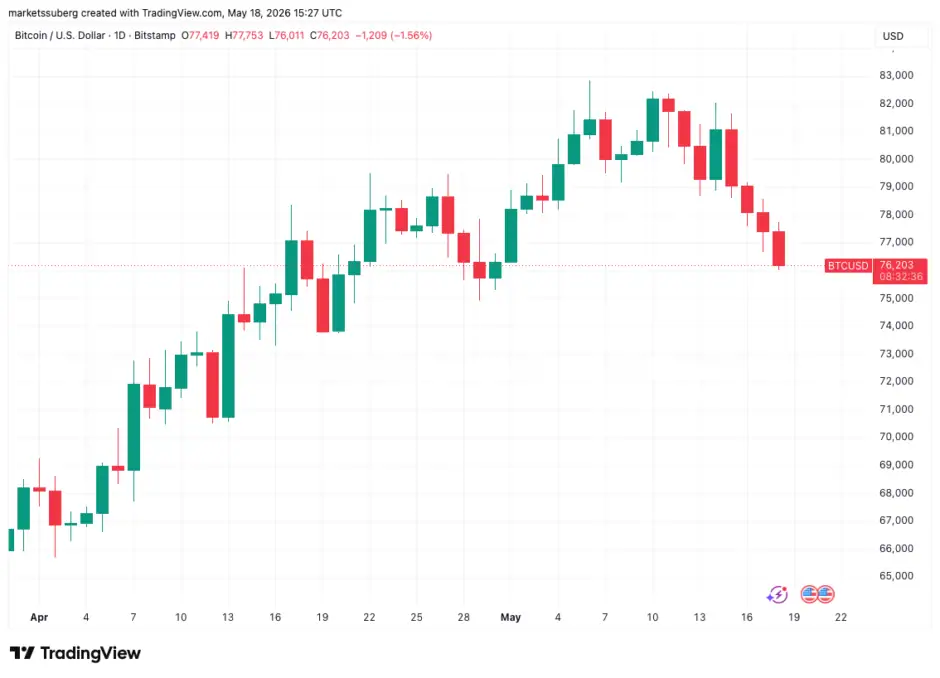
Market analysts say the outflows reflect weakening momentum in crypto markets, despite earlier inflows that had supported Bitcoin’s recovery toward $82,000.
According to market research cited by Bitfinex, monthly capital inflows remain positive at $2.8 billion but are significantly lower than the $10 billion levels typically associated with strong bull cycles, suggesting reduced institutional conviction.
Traders noted that Bitcoin has broken below key technical support levels, including the 21-week exponential moving average and broader bull market support zones.
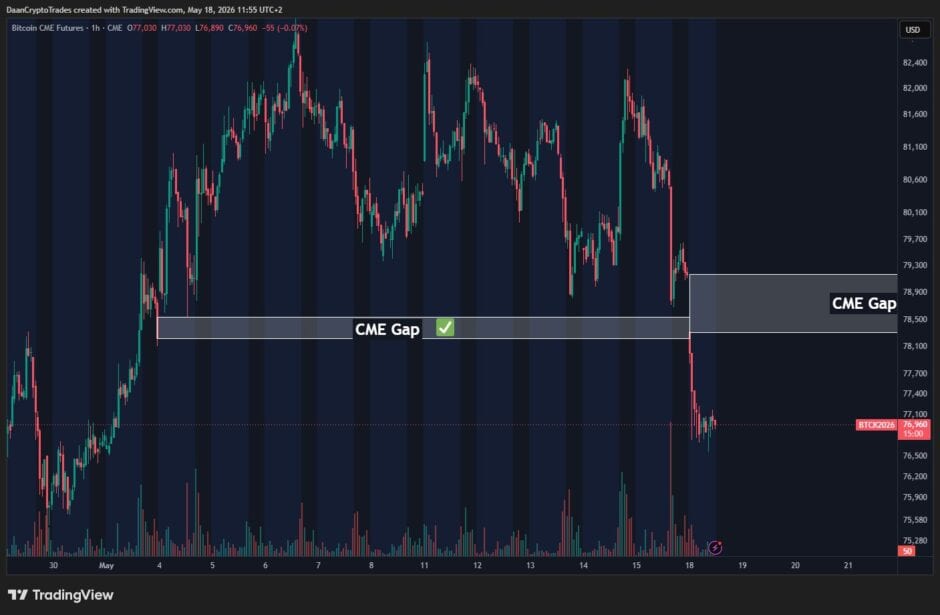
Some analysts also highlighted unfilled CME futures “gaps” at around $79,000, $84,000, and $67,000, which may act as short-term price targets depending on volatility.
Analysts also pointed to macroeconomic pressures, including movements in the Japanese yen and rising US bond yields, which have historically influenced risk assets such as cryptocurrencies.
The USD/JPY pair nearing the psychologically important 160 level has revived concerns about potential intervention from Japanese authorities, adding to global market uncertainty.
While the broader trend remains weak, some traders suggest the recent ETF-driven selloff could signal a local bottom, as similar large outflows have previously preceded price stabilization phases.
Market participants continue to watch institutional flows and macroeconomic indicators closely as Bitcoin attempts to stabilize after a sharp pullback.