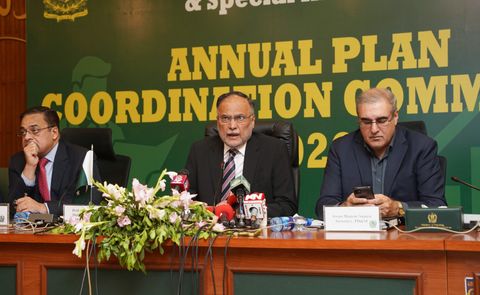
The Annual Plan Coordination Committee (APCC), chaired by Federal Minister for Planning and Development Ahsan Iqbal, has recommended a national development outlay of Rs. 4.715 trillion for fiscal year 2026-27 while emphasizing the need for Pakistan to shift from debt dependence toward an export-led and self-reliant economy.
During the meeting, the committee reviewed development performance for FY2025-26, assessed the Public Sector Development Programme (PSDP), and finalized priorities for the upcoming fiscal year.
Ahsan Iqbal highlighted the sharp decline in development spending over the years, noting that PSDP stood at 19.6% of the national budget and 2.5% of GDP in 2017-18 but has fallen to just 4% of the budget and 0.6% of GDP in 2025-26. He described the PSDP as a critical tool for economic growth, infrastructure development, and public welfare.
The minister stressed that Pakistan’s economic challenges, rising debt servicing costs, and fiscal constraints have significantly reduced development spending capacity. He argued that sustainable economic progress can only be achieved through higher exports, investment, and productivity rather than continued reliance on external borrowing.
“Exports are the master key to economic sovereignty,” Ahsan Iqbal said, urging all government institutions to prioritize export growth and foreign direct investment.
The APCC recommended a total development outlay of Rs. 4.715 trillion for FY2026-27, comprising:
- Federal PSDP: Rs. 1.126 trillion
- Provincial Annual Development Programmes (ADPs): Rs. 3.138 trillion
- State-Owned Enterprises (SOEs) investment: Rs. 451 billion
The committee was informed that ministries and divisions had sought PSDP allocations of Rs. 4.1 trillion, far exceeding the available fiscal space. Due to resource limitations, over 98% of PSDP funding will be directed toward ongoing projects, particularly those nearing completion and those in water, energy, transport, and infrastructure sectors.
The meeting also noted that Pakistan’s ongoing development portfolio has a throw-forward liability exceeding Rs. 10 trillion, creating significant funding pressures. Major projects such as ML-1 railway modernization, Diamer-Bhasha Dam, Dasu Dam, Mohmand Dam, and Thar connectivity schemes remain among the government’s top priorities.
The APCC further emphasized protecting development allocations for Azad Jammu and Kashmir, Gilgit-Baltistan, and the newly merged districts of Khyber Pakhtunkhwa, while giving special attention to underdeveloped regions including Balochistan and Gwadar.
Concluding the session, Ahsan Iqbal called for a national development strategy focused on stability, reforms, continuity, and export expansion, stating that Pakistan must move from economic stabilization toward long-term growth and self-reliance.