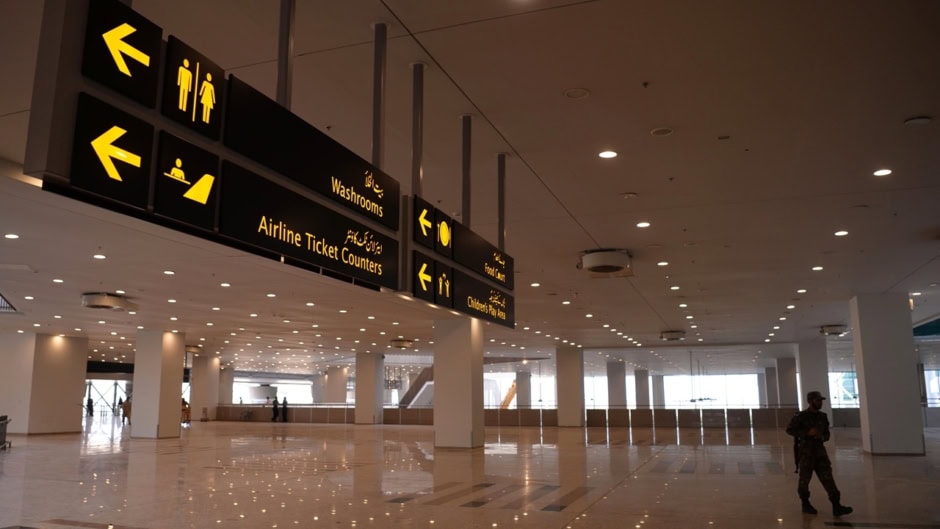
The federal government has included Pakistan’s three major international airports Jinnah International Airport Karachi, Islamabad International Airport, and Allama Iqbal International Airport Lahore in its revised five-year privatisation programme, according to official documents.
The updated roadmap covers 25 state-owned enterprises (SOEs) and will be implemented in three phases. The first phase includes 11 entities targeted for privatisation within the next year, while 13 entities will be considered in the second phase over a period of one to three years. One entity has been placed in the final phase, covering three to five years.
The three airports were not part of the earlier privatisation plan and have now been added to the first phase alongside other major state-owned organisations.
The first phase includes Islamabad Electric Supply Company (IESCO), Faisalabad Electric Supply Company (FESCO), Gujranwala Electric Power Company (GEPCO), Roosevelt Hotel New York, Zarai Taraqiati Bank Limited (ZTBL), House Building Finance Company (HBFC), Pakistan Engineering Company (PECO), and Sindh Engineering Limited.
Pakistan International Airlines (PIA) and First Women Bank Limited (FWBL) have been removed from the latest list as the government considers their privatisation process completed.
The second phase includes several power distribution companies, including Lahore Electric Supply Company (LESCO), Multan Electric Power Company (MEPCO), Hyderabad Electric Supply Company (HESCO), Sukkur Electric Power Company (SEPCO), Peshawar Electric Supply Company (PESCO), and Hazara Electric Supply Company (HAZECO).
Other entities included in the second phase are Utility Stores Corporation (USC), Jamshoro Power Company, Central Power Generation Company Limited (CPGCL), Northern Power Generation Company Limited (NPGCL), Lakhra Power Generation Company Limited (LPGCL), State Life Insurance Corporation of Pakistan, and Pakistan Reinsurance Company Limited (PRCL).
The government has placed Postal Life Insurance Company in the third and final phase of the privatisation programme.
Officials said the revised plan is aimed at reducing the financial burden of state-owned enterprises, attracting private investment, improving efficiency, and increasing the role of the private sector in Pakistan’s economy.