The Pak-China Friendship Centre in Islamabad turned into an arena of whirring machines this week, and the crowds came for the spectacle.
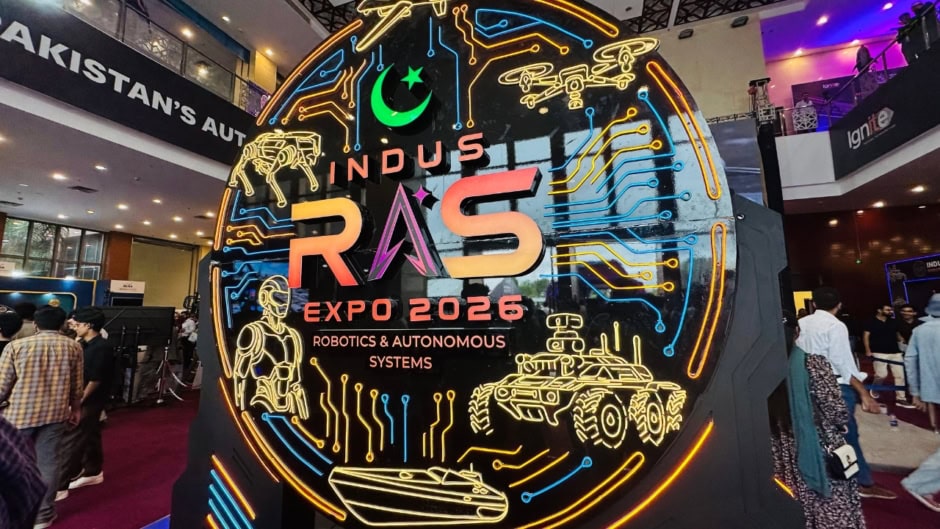
The Indus RAS Expo 2026, Pakistan’s national robotics and autonomous systems showcase, opened on Wednesday with fighting robots, autonomous drones, and rows of locally built prototypes. Organized by Ignite under the IT ministry, alongside NCRA and NUST’s College of E&ME, will run for two days (July 22-23). TechJuice brings to you an exclusive coverage of one of the country’s largest drone & robotics show.
The floor was deliberately varied, spanning the serious and the crowd-pleasing. Exhibits covered defense robotics, drone technologies, industrial automation, maritime autonomous systems, agritech, and physical AI, drawn from universities, research institutions, startups, and public-sector bodies. Live demonstrations let visitors watch machines farm, fly, and navigate rather than simply read about them, which is the difference between a trade show and a genuine draw.
Indus RAS Expo 2026 Exhibitors and What They Showed
| Exhibitor | Category | Key display |
|---|---|---|
| NRTC | Defence | UGVs, UAVs, robodogs, anti-drone, logistics robots |
| Heavy Industries Taxila | Defence | Unmanned aerial systems, armored platforms |
| Cavalier Group | Defence | Surveillance and ISR UAV drones |
| DGRDE | Defence | ISR drone platforms |
| Voyager Electronics | Drones | ISR, FPV, interceptor, heavy-lift UAVs |
| UAS Global | Drones | UAS and counter-UAS systems |
| NaqCoDE | Drones | Combat UAV computational design |
| Sarwar Engineering House | Drones | Precision drone parts and assemblies |
| NRG Tech | University spin-off | Brain-controlled robotics |
| CubeX LMS | Startup | Cu-bit 4.0 Pro unmanned ground vehicle |
| MatEnTx | NUST spin-off | Piezoelectric and soft-robotics sensors |
| NCRA (Swarm Robotics Lab) | Research | Multi-robot coordination, machine vision |
| NCRA (Robot Maker Lab) | Research | Rapid prototyping and fabrication |
| NUST CEME Mechatronics | University | Humanoid robots, autonomous vehicles |
| Aerosolutions | Simulators | Full-motion, VR, XR flight simulators |
| ZATNav | Simulators | GNSS navigation, aerospace simulation |
| Nexa Robots | Service robots | Autonomous hospitality and healthcare robots |
| Switzern / Stratheon | Industrial | Robotic welding and automation |
| ConnecTech (NASTP) | Multi-domain | Industrial, agri, healthcare, aerospace R&D |
| Comcept | Defence AI | Fire control systems, edge computing |
| LearnOBots, Mediatiz, Headstart | Education | STEM kits, robotics curricula, drone labs |
The undisputed star was the RoboWars arena, where students, engineers, and startups pitted original combat robots against each other before a panel of judges, and organizers expected the biggest crowds to gather there, especially on the fuller second day. Alongside it sat the RAS Innovation Challenge, an Immersive Experience Dome blending 360-degree storytelling, and a dedicated drone show.
Prime Minister Shehbaz Sharif inaugurated the event beside Field Marshal Syed Asim Munir, and he arrived with real numbers rather than platitudes. He revealed that 100% of the simulators on display were developed in Pakistan, while more than 60% of the country’s drones are now manufactured locally, calling both proof of growing technological capability.
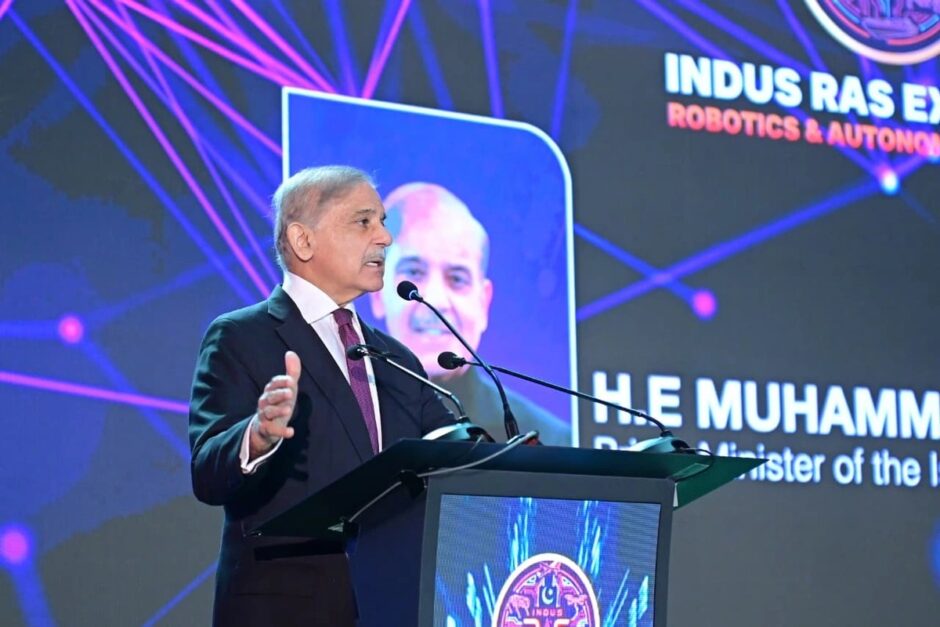
“Let our universities, research and development centres, startups, industries, and farmers become part of one national innovation ecosystem, ensuring that the knowledge behind these technologies is indigenous, owned, and continuously advanced in Pakistan,” he said.
He also brought money and machinery for the ecosystem. Shehbaz announced a $20 million Pakistan Venture Fund to draw investment into local technology, plus the Spark and Elevate programme designed to turn research into commercially viable businesses. His framing was ambitious, and he put it plainly.
“Pakistan will not be a nation that merely inherits the choices made by others,” he said. “We will shape our own destiny through innovation, enterprise, self-reliance and untiring efforts.”
He urged universities, startups, industries, and even farmers to join a single national innovation ecosystem, while stressing that autonomous systems still need clear ethical and regulatory guardrails.
The practical aspect of the artifacrs shown may have a primary disposition towards defense, but they can also be used to detect crop diseases, optimize water and fertilizer use, and aid disaster response. The latter matters for a country facing water shortages and climate stress.
Whether the fund and the fanfare translate into products beyond the expo floor is the real test, yet for two days at least, Pakistan’s robotics ambitions has a physical body.