Scientists have found a remarkably gentle way to rewrite the rules inside a quantum material, and it could matter for the computers of the future. Researchers at Japan’s Okinawa Institute of Science and Technology and Hiroshima University discovered that a tiny magnetic nudge can transform the electronic landscape of a layered material called cerium tritelluride. With just a slight tilt of a magnetic field, the pattern flips from parallel stripes into a neat checkerboard.
That sounds small, yet it upends a stubborn problem. Forcing electrons in a quantum material to adopt a new formation usually demands a heavy hit of power, which makes precise control difficult. So achieving the same switch with only a weak field is exactly the kind of low-energy control that future technology needs.
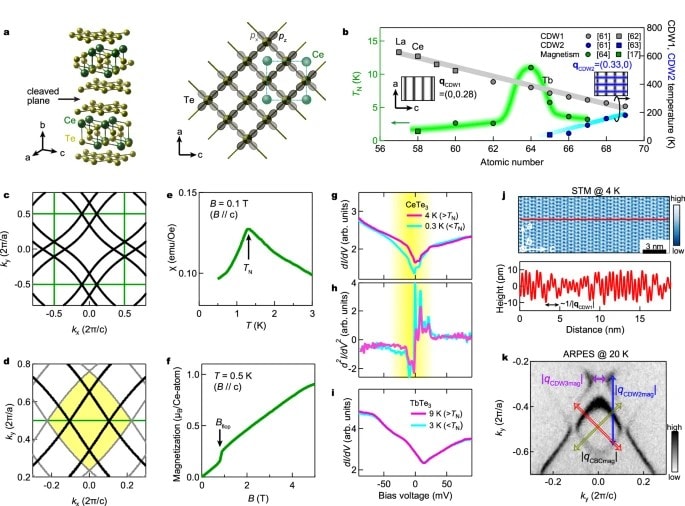
Understanding why it works means looking at how the material is built. Cerium tritelluride is a two-dimensional layered material, a little like graphene, with ultrafast mobile electrons. The clever part is a division of labour between two atoms, since tellurium layers act as highways where electrons zip around and form wave-like patterns, while cerium layers hold stationary electrons that behave like tiny fixed bar magnets.
“CeTe₃ offers a rare opportunity to watch mobile electrons and localized spins work together. We wanted to directly visualize how this cooperation gives rise to collective electronic states,” said Yuita Fujisawa, co-first author and an assistant professor at Hiroshima University.
“CeTe₃ is antiferromagnetic, which usually means that neighboring spins point in opposite directions. But in this case, we found that the magnetic moments form a much more intricate repeating pattern,” said Dr. Ryutaro Okuma, leading a companion team.
The big question was whether those two worlds could influence each other. The answer proved to be a dramatic yes, since the stationary magnetic spins can reshape the paths of the fast-moving electrons. Using scanning tunnelling microscopy cooled near absolute zero, the team watched the mobile electrons line up in crisp stripes, then snap into a checkerboard the moment the magnetic field tilted.
The secret is a concept called electronic frustration. In this material, electrons can settle into several nearly identical low-energy patterns without strongly preferring any one, like a ball resting among near-identical valleys. So a tiny magnetic push is all it takes to tip the balance from one arrangement to another.
A companion study using neutron scattering confirmed the deeper link, revealing that the material’s magnetic order directly drives these shifting electronic states. Published in Nature Communications, the findings offer a playbook for controlling information at the atomic scale, which is precisely what spintronics and quantum computing will require.
The Discovery in Brief
| Element | Detail |
|---|---|
| Material | Cerium tritelluride (CeTe₃), a 2D layered quantum material |
| What changed | Electronic pattern flipped from stripes to checkerboard |
| Trigger | A small tilt of a weak magnetic field |
| Why it is rare | Such switches normally need heavy power |
| Key concept | Electronic frustration, many near-equal low-energy states |
| Tellurium layers | Fast mobile electrons forming wave patterns |
| Cerium layers | Fixed electrons acting as tiny magnets |
| Tools used | Scanning tunnelling microscopy, neutron scattering |
| Published in | Nature Communications |
| Potential use | Spintronics, quantum computing architectures |