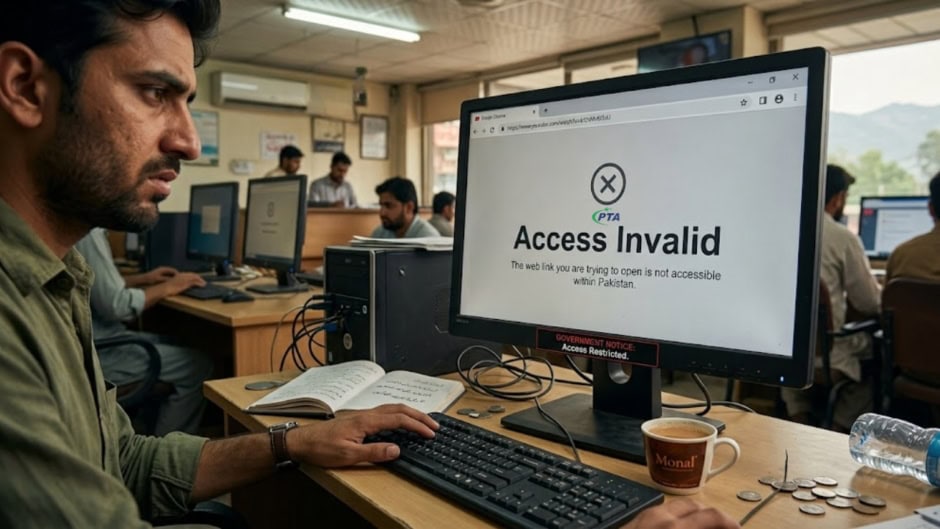
The Pakistan Telecommunication Authority (PTA) blocked over 1.54 million online URLs across major digital platforms by July 2026. Official PTA data shows a takedown rate of 89.4%, meaning nearly nine out of every ten reported links were removed.
PTA processed 1,726,303 URLs in total. Of those, 1,542,800 were blocked. Another 76,874 remain under review. The regulator rejected 106,629 complaints entirely.
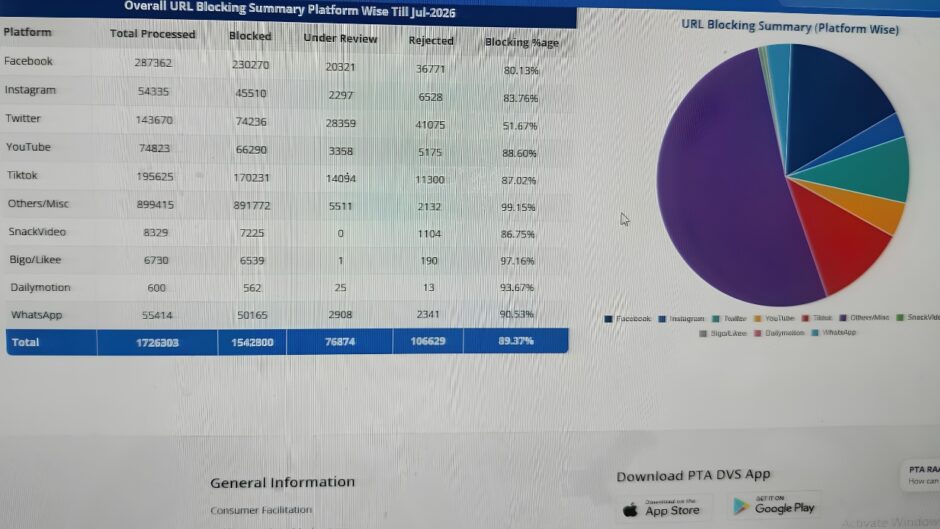
The “Others/Misc” category accounted for the largest share of blocks at 891,772 URLs. That category carried a 99.15% blocking rate, the highest across all segments. The classification covers content outside major social platforms, though PTA does not publicly break down what falls under this label. The near-total blocking rate raises questions about oversight and whether individual URLs receive meaningful review at that volume.
Facebook led among social media platforms in absolute numbers. PTA blocked 230,270 URLs out of 287,362 processed. TikTok followed at 170,231 blocked URLs. X (formerly Twitter) recorded 74,236 blocks. YouTube posted the highest platform-specific blocking rate at 88.6%, with 66,290 of 74,823 URLs taken down. WhatsApp saw 50,165 blocks at a 90.53% rate. Instagram recorded 45,510 at 83.76%.
Smaller platforms also faced restrictions. SnackVideo had 7,225 URLs blocked. Bigo and Likee combined for 6,539 blocks. Dailymotion recorded 562.
The scale reveals a regulatory apparatus operating at industrial volume. Blocking 1.54 million URLs requires either massive automated filtering or a review workforce processing thousands of decisions daily. PTA has not disclosed which approach it uses or how it handles false positives at this scale.
The data arrives during a period of heightened scrutiny over Pakistan’s digital regulation. PTA recently signed a Letter of Intent with Meta on digital safety. The Islamabad High Court and Lahore High Court are both hearing petitions on social media regulation for minors. Yet the regulator’s approach remains reactive rather than legislative. URLs are blocked individually after complaints rather than through systemic platform-level policy requirements.
In contrast, the European Union’s Digital Services Act requires platforms to moderate content proactively. Australia mandates age verification systems. Meanwhile, Pakistan blocks URLs one at a time, 1.54 million times over.