
Canada-based BTQ Technologies and Taiwan’s Industrial Technology Research Institute (ITRI) have completed the first milestone in validating a new chip architecture designed to accelerate post-quantum cryptography directly inside the memory subsystem rather than shuttling data between separate processing and storage components.
The Quantum Compute-in-Memory (QCIM) architecture passed functional testing in a TSMC 28-nanometer design environment on August 9, successfully handling cryptographic operations tied to three NIST post-quantum standards.
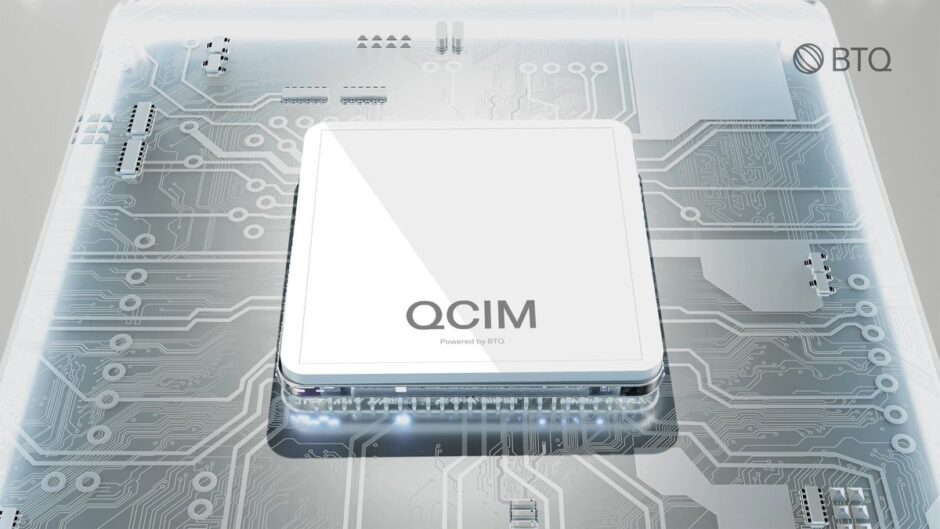
The core innovation sits in where the cryptography actually happens inside the chip’s physical architecture. Traditional processors move data from memory to a separate compute unit, perform the cryptographic operation, and then move the result back to memory.
Each transfer consumes power, introduces latency, and creates potential side-channel attack surfaces. QCIM eliminates that movement by performing cryptographic computations directly inside the memory subsystem, reducing energy consumption and processing time while shrinking the chip’s physical footprint.
The architecture successfully accelerated algorithms associated with FIPS 203, 204, and 205, which form the core of NIST’s emerging post-quantum cryptography standards finalized in 2024.
These standards were developed specifically because today’s widely used encryption methods will become vulnerable once quantum computers reach sufficient scale, and organizations ranging from banks to military systems need hardware that can run the replacement algorithms efficiently. BTQ designed the architecture to be “crypto-agile,” meaning it can support additional algorithms as security requirements evolve without requiring new silicon.
The collaboration draws on three distinct areas of semiconductor expertise that would be difficult for any single company to replicate alone. BTQ contributes the cryptographic architecture itself, South Korean firm ICTK provides secure semiconductor and physical unclonable function capabilities for device authentication, and ITRI brings decades of semiconductor design, integration, and validation experience to the fabrication and testing process.
“This milestone is an important technical and commercial step in the global QCIM roadmap being led by BTQ and ICTK,” said Olivier Roussy Newton, CEO and Chairman of BTQ Technologies. “The results demonstrate that the QCIM architecture can accurately and efficiently accelerate multiple NIST-standardized post-quantum cryptographic algorithms under demanding conditions while maintaining the flexibility required to respond to evolving security standards. As post-quantum security moves from standardization toward implementation, organizations will require hardware that can deliver stronger cryptographic protection without creating unacceptable performance, power or deployment constraints,” continued Roussy Newton. “The work completed with ITRI provides a stronger foundation for integrating QCIM into the devices and infrastructure supporting military, industrial, automotive, IoT and Physical AI systems.”

The target applications span military systems, industrial equipment, automotive technology, IoT devices, edge computing platforms, and AI-enabled infrastructure. These are environments where long-term security, device authentication, and efficient cryptographic processing matter most because the devices themselves often operate for decades and cannot be easily replaced when encryption standards change.
BTQ expects to ship test chips to selected customers and strategic partners by the end of 2026 for performance and functional validation, with the next phase focusing on module-level integration, verification, and broader system compatibility testing.