A civil litigation attorney built an AI server from eight used 2018-era NVIDIA Tesla V100 data center GPUs. The entire point is privacy. Case files never leave the office, and no client data touches a cloud service. The server runs DeepSeek V4.1 Flash entirely in GPU memory at up to 215 tokens per second for code and 118 tokens per second for legal writing.
The cost was remarkably low for what the system delivers.
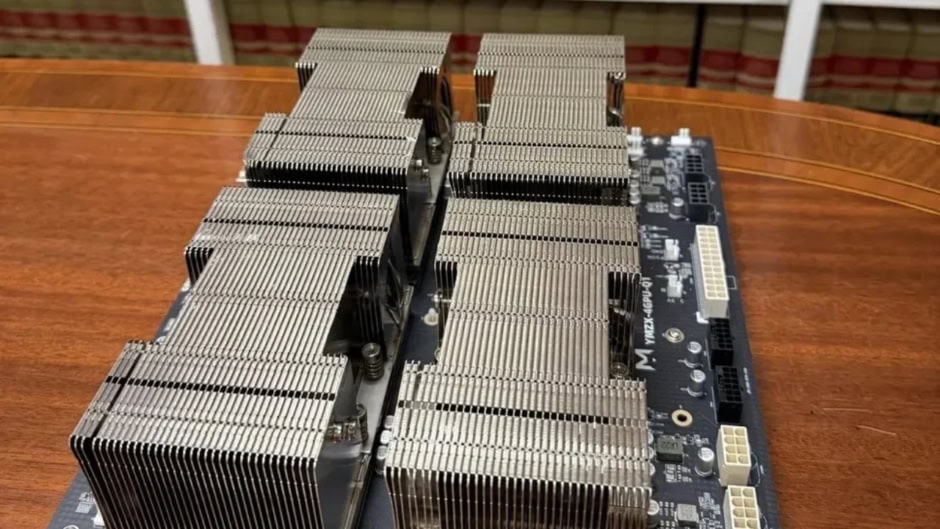
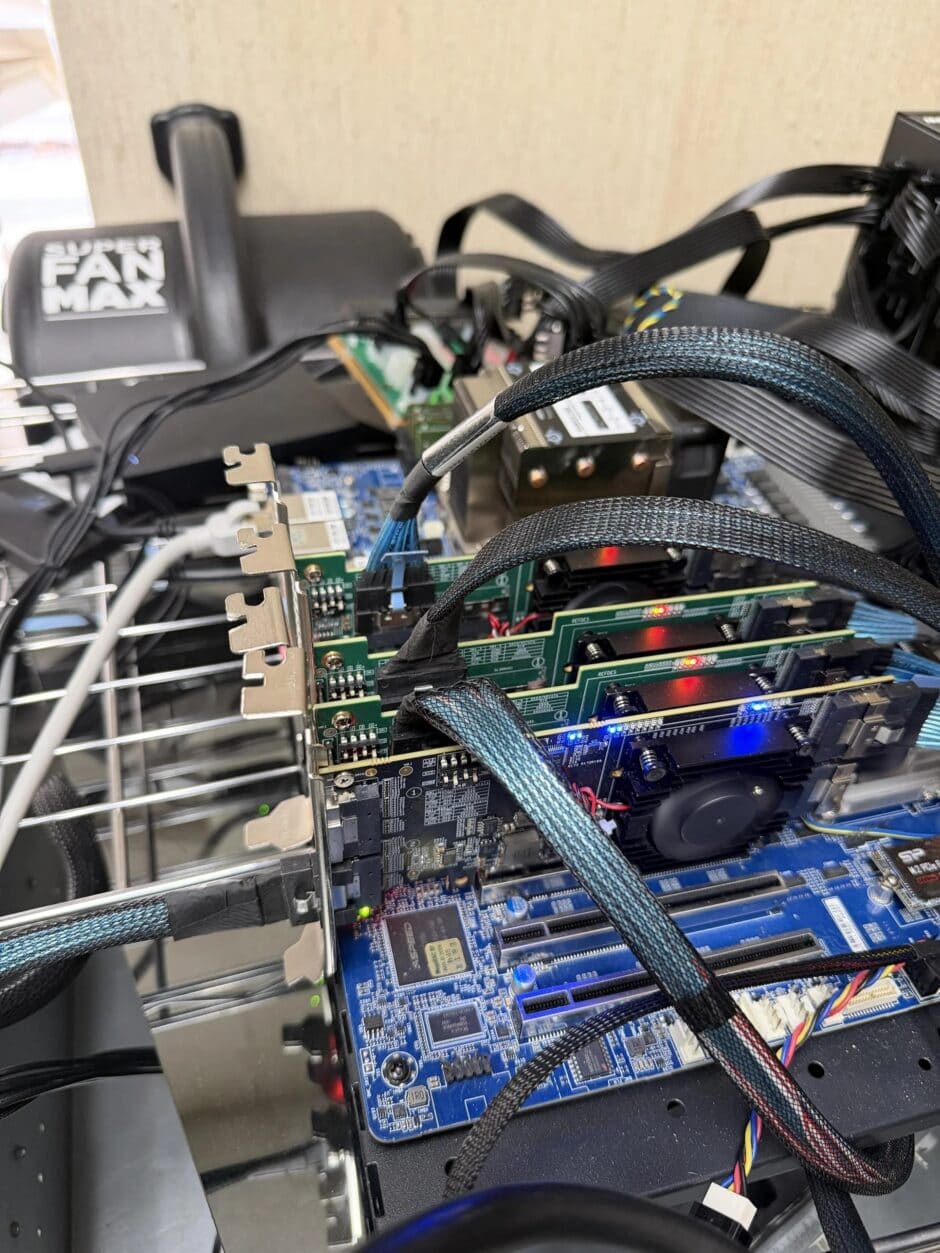
Two four-GPU SXM2 NVLink boards cost roughly $2,400 each when the lawyer purchased them. Each of the eight Tesla V100-SXM2-32GB cards carries 32GB of HBM2 memory running at 900 GB/s bandwidth. Inside each board, all four cards communicate over NVLink, giving 128GB of combined GPU memory per board. However, the two boards only talk to each other over the slower PCIe bus. The rest of the system includes a Gigabyte Threadripper Pro motherboard, a 12-core AMD 3945WX chip, 256GB of DDR4 RDIMM, and two power supplies delivering 2,800W across two regular office circuits.
Getting everything stable required real troubleshooting. The host crashed twice from fatal PCIe errors when GPU clocks ran uncapped. At full power, cards drew up to 232W each, well past the 180W limit. One board’s power connector showed a visible burn mark. The lawyer removed that board and capped every remaining card at 150W with clocks limited to 1,522 MHz. Additionally, the system RAM hit uncorrected ECC errors until the speed dropped from DDR4-3200 to DDR4-2666.
Despite those constraints, performance scales well. DeepSeek V4.1 Flash runs at mostly 2-bit compression with weights totaling 248.8GB. The model’s expert layers sit entirely in GPU memory. Meanwhile, about 110GB of lookup tables stay in system RAM. Fetching from RAM adds roughly 0.12 milliseconds per step, which barely affects speed.
How the model splits across the two boards proved critical. The first 20 layers run on one board. The second 20 layers run on the other. Each board handles heavy traffic over its own NVLink. As a result, only one handoff per step crosses the slower PCIe link between boards. An earlier attempt to distribute every layer across all eight cards caused speeds to collapse because of that PCIe bottleneck. With the current split, code generation hits 215 tokens per second at 1,000-token prompts. Legal writing reaches 118 tokens per second. At 128,000 tokens, the first response takes about a minute.
The server handles daily first-pass legal work. It reads folders of case records, extracts facts, dates, and figures, generates summaries, and drafts routine documents. Nothing goes out without human review. RAG databases and tool calls connect through a Discord-style interface over SSH. For now, it processes one request at a time.
The lawyer estimates that 50% to 60% of existing AI workflows now skip frontier models entirely. A second DeepSeek server running on two NVIDIA DGX Sparks handles the rest. Both systems hand work to each other.
While people online were applauding the lawyer’s efforts, some even went ahead to help him secure his set-up:
Comment
by
u/TumbleweedNew6515 from discussion
in
homelab
There is one looming risk, though. The NVIDIA R580 driver branch is the last to support the Volta architecture powering the V100. Once NVIDIA drops that branch, the hardware loses official software support. On top of that, used V100 prices on eBay have already climbed from roughly $400 per card to about $900. For anyone considering a similar build, the window is narrowing on both fronts.
For the legal profession broadly, this build demonstrates something important. Running capable AI models locally is no longer limited to tech companies with data center budgets. A lawyer with used hardware and two office circuits built a system that handles real case work at production speeds. In a profession where client confidentiality is not optional, that matters more than any benchmark.