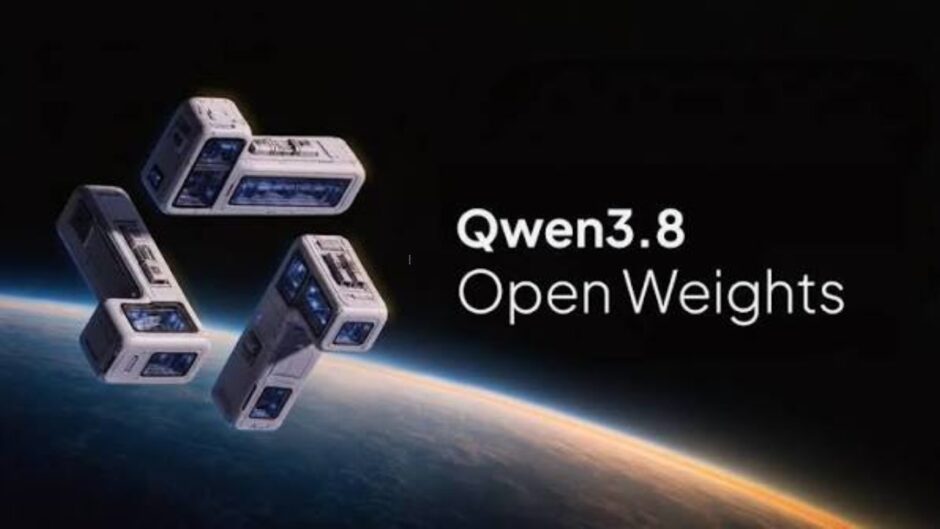
Alibaba released Qwen3.8-2.4T-A95B, the text-only open-weight checkpoint behind its managed Qwen3.8-Max service.
The checkpoint became publicly available on Hugging Face and represents the first open release of a Max-class model in the Qwen family. Critically, the downloadable checkpoint is text-only and always uses thinking mode, while the managed Qwen3.8-Max service adds vision input, non-thinking mode, and built-in tools that the open version excludes.
The model has 2.4 trillion total parameters but activates only 95 billion parameters for each operation. It does so through a sparse mixture-of-experts architecture and hybrid attention mechanism designed to reduce computing requirements and latency compared with similarly sized dense models.
The layer structure follows a repeating pattern with 23 blocks. Each block contains three units of Gated DeltaNet followed by MoE, followed by one unit of Gated Attention followed by MoE, mixing linear attention with standard gated attention. The official model card lists a native context length of 262,144 tokens, extendable to 1,010,000, and exposes reasoning_effort and preserve_thinking controls.
The efficiency advantage matters economically. The mixture-of-experts design activates only approximately 95 billion of 2.4 trillion parameters per request, which lets Alibaba credibly undercut US frontier pricing rather than merely match capability.
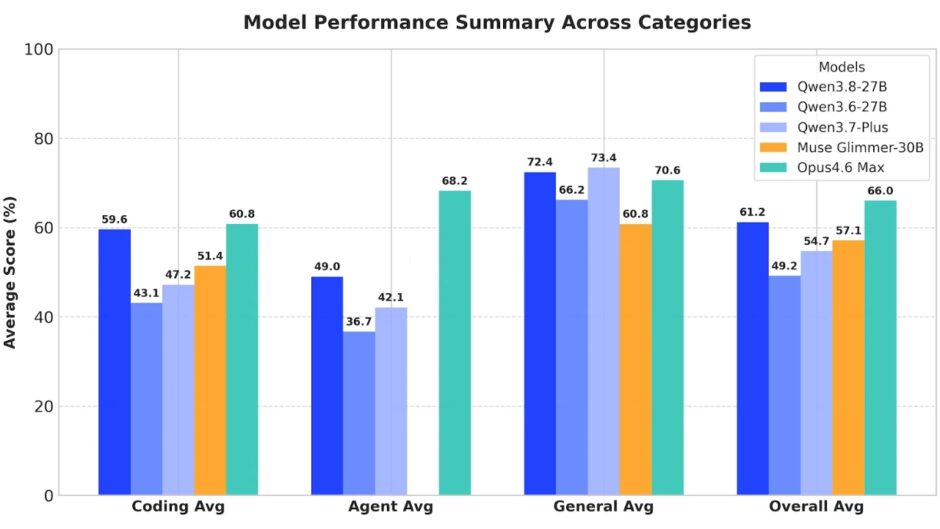
Chinese labs are producing models that are highly competitive on benchmarks while using a fraction of the parameters. By extension, these models utilize a fraction of the compute and chip access that US labs can draw on. Performance benchmarks show competitive positioning. The model ranks second on Vision Arena and fifth on Text Arena, trailing only Anthropic’s Claude Fable 5 in overall performance.
NVIDIA says multinode, data-center-scale accelerated systems are required for the model. Moreover, more than 4,000 tokens per second per GPU and more than 350 tokens per second per user. That too without extra model tuning on a GB300 NVL72 system at FP8 precision.
Storage, loading, expert placement, interconnect bandwidth, and quantization remain significant constraints even though only 4% of parameters activate per token. Organizations planning hosted services should review the license against their product design and revenue profile before committing deployment resources.
The custom license creates commercial boundaries. The checkpoint uses the Qwen3.8-Max License rather than Apache 2.0. That requires prominent model-name display for covered commercial products or services above 100 million monthly active users or $20 million in monthly revenue. Also, it requires a separate Qwen license when aggregate revenue exceeds $50 million during any consecutive 12 months. Technical access and commercial permission are therefore separate decisions.
The weights enable independent testing of long-context reasoning and coding, but hosted-service teams must verify licensing compliance before scaling to production.