Anthropic launched Claude Fable 5.1 and Claude Mythos 5.1 on September 1, 2026, calling them the world’s most advanced models for coding and knowledge work. Both models share identical architecture but differ in safeguards, with Fable 5.1 generally available while Mythos 5.1 remains restricted to vetted cybersecurity and life sciences professionals through trusted access programs.
Sharp Cost Reductions
The most immediate change for developers involves pricing. Fable 5.1 costs roughly 25% less than Fable 5 for typical workloads, and up to 45% less for highly agentic tasks. This stems primarily from a 75% reduction in cache read pricing, now just $0.25 per million tokens.
Base pricing otherwise remains unchanged at $10 per million input tokens and $50 per million output tokens. Because cache reads dominate the cost of context-heavy work, this single change reshapes the economics for developers running large, tool-heavy workloads.
A New Performance Frontier
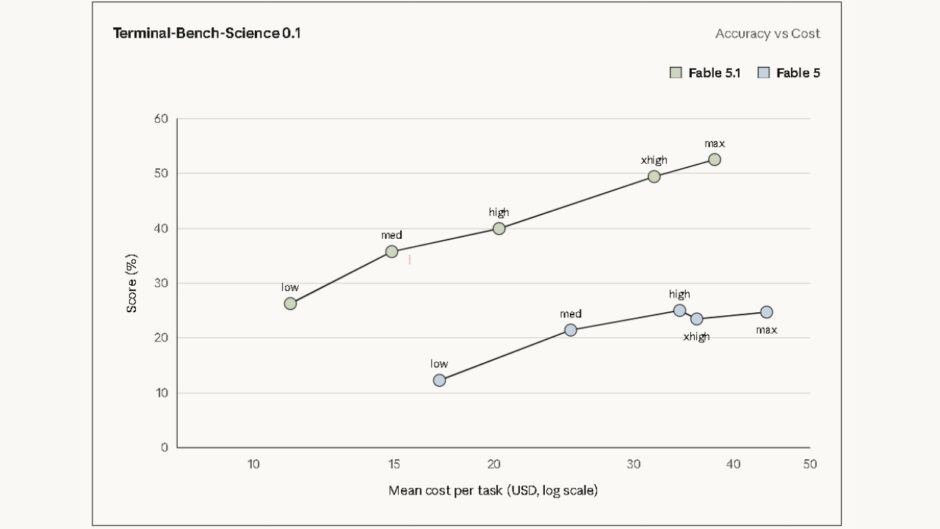
Fable 5.1 sets a new standard for long-running problem-solving, avoiding shortcuts that produce poorer-quality work while fixing root causes of software issues. It scored 55.8% on Terminal-Bench 4.0 coding tests, ahead of Opus 5’s 42.0% and GPT-5.6’s 37.3%. On scientific research, it reached 52.6% on Terminal-Bench-Science 0.1, more than doubling Fable 5’s 24.7%. Both models support one million tokens of context, with output reaching 128,000 tokens per response.
| Fable 5.1 | Fable 5 | Opus 5 | GPT-5.6 Sol | |
|---|---|---|---|---|
| Agentic scientific researchTerminal-Bench-Science 0.1 [1] | 52.6% | 24.7% | 29.0% | 22.4% |
| Agentic codingTerminal-Bench 4.0 | 55.8%60.9% (Mythos 5.1) | 42.0% | 52.3% | 37.3% |
| Knowledge workGDPval-AA v2 | 1853 | 1723 | 1824 | 1711 |
| Computer useOSWorld 2.0 [2] | 77.9% partial |
72.9% partial |
75.4% partial |
— |
| Computer useOSWorld 2.0 | 41.7% strict |
36.1% strict |
39.6% strict |
— |
| Multidisciplinary reasoningHumanity’s Last Exam | 60.9% no tools |
57.8% no tools |
56.6% no tools |
— |
| 65.0% with tools |
63.8% with tools |
63.6% with tools |
— | |
| Business workflowsAutomationBench | 31.4% | 17.1% | 26.9% | 19.6% |
| Agentic codingCursorBench 3.2.0 | 73.4% | 70.5% | 70.0% | 67.2% |
Early-access partners echoed these gains. Cognition, maker of the Devin coding agent, said it moved its Opus 5 traffic to Fable 5.1 on launch day after it matched or edged out Fable 5 at lower cost. Millennium reported the model traced a one-in-a-million crash by disassembling an external vendor library, a bug its team had failed to explain for four to five years.
Striking Scientific Capabilities
The models demonstrated genuine research potential across multiple domains. Claude Mythos 5.1 designed high-affinity protein binders with binding affinities 10 times higher than the best designs submitted to Adaptyv Bio’s competitions, achieving a nearly 50% hit rate where 10 to 15% is typical. Meanwhile, Fable 5.1 trained a neural network to create a new high-resolution elevation map covering a third of Venus, using NASA Magellan radar images captured over 30 years ago. Anthropic released that map under a Creative Commons license ahead of upcoming NASA VERITAS and ESA EnVision missions.
In computational biology, Mythos 5.1 wrote custom GPU kernels that sped up seven open-source deep learning models by up to 2.5 times with identical outputs. Because biologists run these models thousands of times per experiment, the optimizations cut estimated GPU costs by 30 to 60%, work that normally takes performance engineers weeks.
Refined Safeguards and Privacy
Anthropic also improved its safeguards to reduce false positives significantly. Cybersecurity safeguards now block 60% fewer false positives, allowing Fable 5.1 to identify software vulnerabilities though not develop exploits. Biology safeguards fire 85% less often on benign medical questions.
Additionally, the company introduced Enterprise Frontier Safeguards, giving customers zero-data-retention privacy by storing data on their own cloud infrastructure rather than Anthropic’s systems.
Watermarking and Anti-Distillation
To comply with the EU AI Act, Anthropic added an invisible watermark to outputs of models released after August 2, 2026, alongside a detection API now in private preview for regulators, researchers, and obligated enterprises. The company also strengthened anti-distillation defenses, blocking new API accounts from editing Claude’s prior thinking in multi-turn conversations, closing a documented technique used to extract model capabilities.
The release follows Anthropic’s June 2026 suspension of earlier Fable 5 and Mythos 5 models due to US export control actions, before access was restored that same month.