A team of researchers has created four new gasoline blends that could make combustion engines cleaner. The fuels aim to reduce emissions without requiring drivers to buy new vehicles. Crucially, they remain fully compatible with the engines already on roads today.
Scientists at the University of Sharjah’s Research Institute of Sciences and Engineering led the work. Their four blends are named HyperFuel-95, HyperFuel-98, HyperFuel-100, and HyperFuel-102. Each number reflects the fuel’s octane rating, with the highest reaching 102. The research appeared in the journal Thermal Science and Engineering Progress.
The study tackles two problems at once. First, it addresses the environmental impact of transportation fuels. Second, it responds to the gradual depletion of petroleum resources. According to the authors, this marks the first successful development of these particular hybrid, low-carbon gasoline formulations. They note such recipes are not documented elsewhere in existing literature.
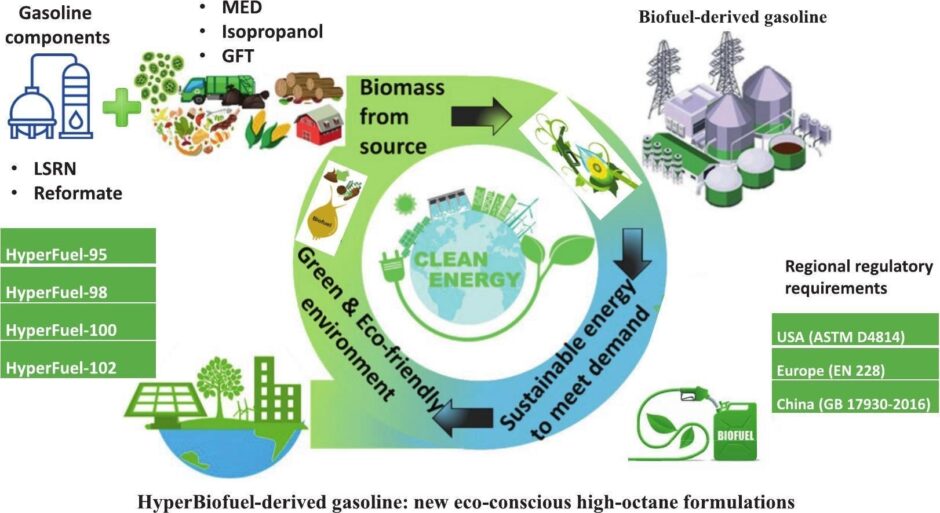
The blends combine conventional petroleum streams with renewable additives. Petroleum components include Fischer-Tropsch gasoline, reformate, and light straight-run naphtha. Meanwhile, the renewable side features isopropanol and a compound called methyl ester of dimate, or MED. Notably, this study marks the first time MED has been used as a gasoline additive.
MED proved to be the standout ingredient. Researchers made it by methoxylating a compound called dimate. It delivered exceptional knock resistance, outperforming every other component tested. In fact, the team ranked the additives by effectiveness. The order placed MED first, followed by reformate, isopropanol, and the petroleum bases.
The performance testing was thorough and standardized. Researchers measured octane, density, vapor pressure, and oxidation stability. They also tracked drivability across the range. The drivability index climbed steadily with each grade. It rose from roughly 455 for HyperFuel-95 to 504 for HyperFuel-102.
“Significant originality is presented in the current work on providing a new propulsion technology for successfully producing new recipes for hybrid low-carbon, eco-friendly, high-octane Hyperbiofuel-derived gasoline by leveraging these refined fuel fractions and renewable petrol additives,” the researchers noted.
Importantly, the blends met fuel quality standards across the US, Europe, and China. They maintained low sulfur and benzene levels throughout. However, significant challenges remain before commercial rollout. The researchers stress that full economic evaluations and lifecycle carbon tracking are still needed. Supply-chain analysis must also happen first. Even so, the work suggests renewable additives could extend the life of combustion engines meaningfully during the broader energy transition.
You can read the whole research here.