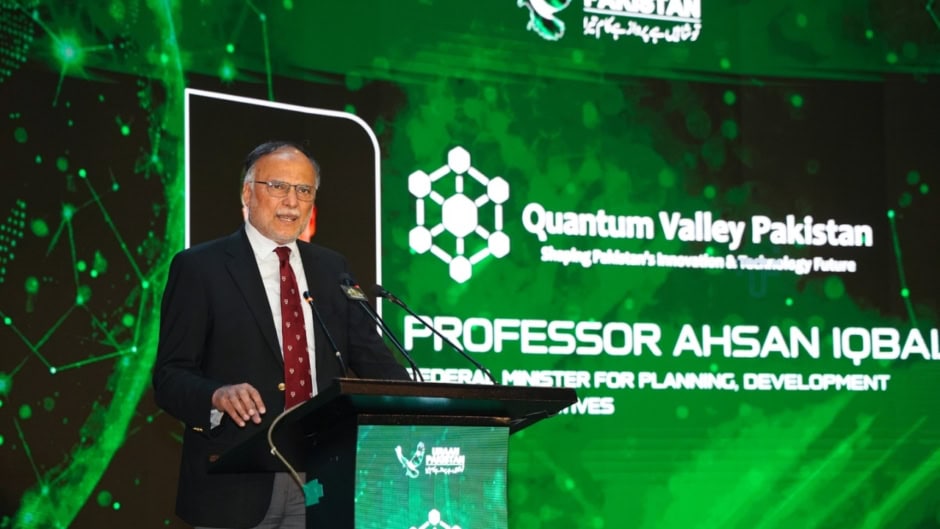
Federal Planning Minister Ahsan Iqbal inaugurated Quantum Valley Pakistan on Wednesday at 3:58 PM Pakistan Standard Time (UTC+5). The launch ceremony took place in Islamabad with international tech leaders present. The initiative aims to connect Pakistan’s youth with global technology and innovation networks. Ahsan Iqbal called it a pivotal moment for the nation’s technological future.
Two formal agreements were signed during the ceremony. Cambridge Innovation Center partnered with Quantum Valley Pakistan as the first agreement. Plug and Play signed the second agreement to support the innovation ecosystem. Tim Rowe, CEO of Cambridge Innovation Center, attended alongside Dougan Sherwood and Seena Amidi from Plug and Play.
Ahsan Iqbal described the launch as marking a new direction for Pakistan. The centre of power in the 21st century relies on intellectual capability, not physical strength. Nations with the best ideas and execution power will dominate the global economy. Pakistan’s 60% youth population represents enormous untapped talent and potential.
“Pakistan’s youth can earn millions of dollars in foreign exchange for the country through knowledge and technology,” he said. “Our objective is to enable Pakistan to achieve a leading position in technology and innovation globally.”
Quantum Valley Pakistan will serve as a bridge to international innovation hubs. The platform brings together universities, research institutions, startups, and government organizations. It eliminates silos within Pakistan’s fragmented technology ecosystem. The initiative creates a unified space for collaboration and advancement.
The framework was developed in partnership with St John’s Innovation Centre at Cambridge University. Since the planning stages began in 2025, the government has integrated lessons from Silicon Valley’s early development. The strategy includes civil-military fusion to accelerate technological breakthroughs. Earlier initiatives like National Centers for AI, Robotics, and Cybersecurity built the foundation for this consolidated effort.
Pakistan’s government targets a $1 trillion economy by 2035 and $3 trillion by 2047. Current population of 260 million requires annual foreign exchange generation of $400 billion. The country needs to increase exports to $100 billion by 2035 as a key milestone. Knowledge and technology exports represent the fastest path to these targets.
The initiative covers emerging fields including artificial intelligence, biotechnology, agri-tech, and quantum computing. National research centers established in 2017 provide existing capacity in data science and automation. URAAN Pakistan, launched in 2024, accelerates the technology journey across multiple sectors. Quantum Valley consolidates these scattered efforts into one comprehensive ecosystem.
Ahsan Iqbal stated Pakistan’s youth can earn millions in foreign exchange through knowledge and technology.
“We have to bring together our capabilities and move forward with the spirit of Team Pakistan,” he said.
The transformation requires moving from job-seeking mindset to innovation architecture.