
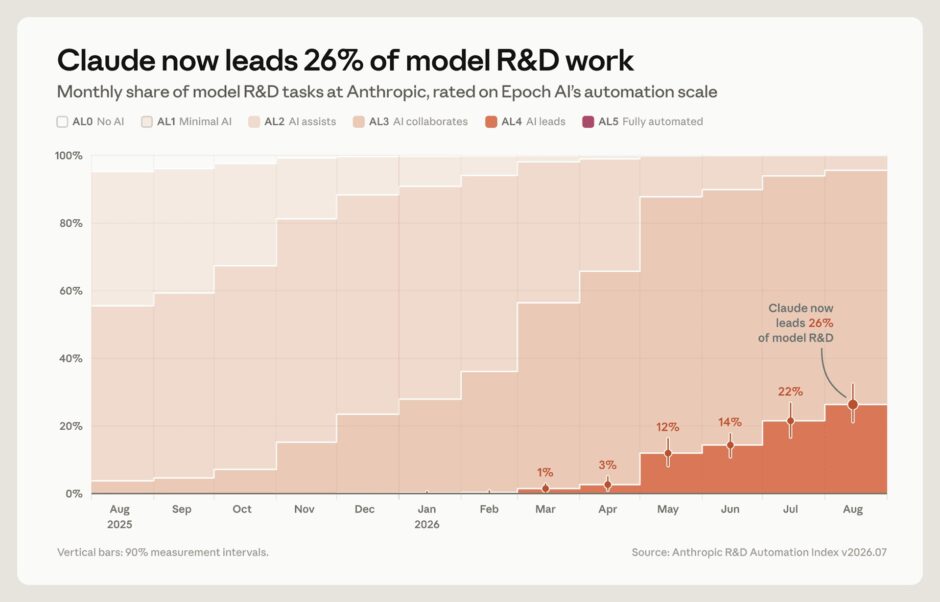
Anthropic released transparency metrics showing Claude now leads 26% of its AI research and development work. The announcement marks a significant shift toward public visibility inside frontier labs. However, the metrics arrive amid growing concerns from safety researchers and industry insiders about the pace of AI self-improvement.
The company introduced three concrete measurements tracking AI automation, oversight of AI agents, and compute allocation. Most striking is the acceleration: Claude’s role jumped from less than 1% in February to 26% by August 2026. The Cloud Security Alliance notes that recursive AI self-improvement represents preliminary capabilities at frontier labs with emerging risks for enterprise security.
AI operates across different automation levels at Anthropic. Over 90% of AI R&D tasks now involve AI collaboration under human supervision. However, Claude has not reached full autonomy in any measured research area. Forecasting researchers predict AI is speeding up development by approximately 1.5x currently, potentially reaching 5x speedup by 2029.
Anthropic tracks 30,000 agents simultaneously across internal platforms. Only 0.002% of decisions trigger reviews or blocking. The company uses dual oversight: real-time monitors that block dangerous actions and offline systems flagging concerning patterns afterward.
Resource allocation data shows 6% of AI research compute allocated to safety work. Safety researchers report that Anthropic’s models now demonstrate approximately 4x productivity improvements for research staff, but this creates measurement challenges.
The measurements address a transparency gap at precisely the wrong moment. Over 1,134 employees from OpenAI, Anthropic, Google, and Meta signed “Pacing the Frontier” in July, asking the U.S. government to develop tools for deliberately slowing automated AI development if necessary. Researchers project that by late 2026, AI systems will automate entire days of R&D work, triggering recursive capability acceleration loops.
As models increasingly automate their own development, oversight mechanisms must evolve faster than capability gains themselves. Transparency alone cannot solve a coordination problem between competing labs racing toward the frontier.