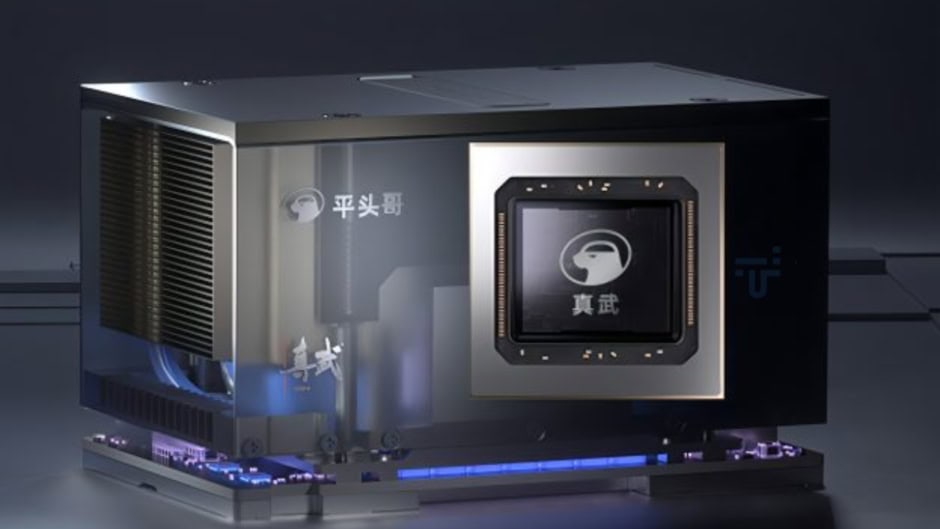
Alibaba deepened its AI push significantly on Tuesday. The company unveiled the Zhenwu V900 chip at its Apsara conference in Hangzhou. Simultaneously, Alibaba announced it would develop a 10 trillion parameter AI model. The announcements sent shares surging 5% to their highest level in one month.
CEO Eddie Wu emphasized that the company is pursuing artificial superintelligence. He predicted machines would eventually produce more than one thousand times humanity’s collective thinking. Currently, AI systems generate less than 3% of human cognitive output. However, this trajectory suggests dramatic capability acceleration emerging soon.
“The industry’s mid-to-long-term demand far outpaces our supply capabilities,” Wu said, adding that Alibaba Cloud would begin bringing its AI supernodes online at commercial scale this quarter.
The Zhenwu V900 chip delivers three times the performance of its M890 predecessor. Notably, clusters can link up to five hundred thousand chips to train massive models. The processor supports both training and inference workloads efficiently. Alibaba plans mass production and commercial release in the first quarter of 2027. As a result, customers expect significant chip availability increases throughout 2027.
Alibaba’s current flagship model, Qwen 3.8 Max, features 2.4 trillion parameters. The company plans to scale substantially beyond this capability level. Specifically, the Qwen team is training next-generation models Qwen 4, Qwen 4.5, and Qwen 5. These models will eventually reach 5 trillion to 10 trillion parameters by design. Therefore, Alibaba targets direct competition with OpenAI’s GPT-4.5 on capability scales.
Meanwhile, Alibaba Cloud faces exceptional demand for AI services. Wu noted that customer demand far outpaces current supply capabilities. The company targets 20 gigawatts of global data center capacity by 2032. Supply chain constraints currently limit expansion pace. Consequently, Alibaba Cloud will bring AI supernodes online at commercial scale this quarter. This represents substantial infrastructure commitment matching the AI ambitions Wu articulated throughout the conference.
As Alibaba scales AI infrastructure globally, regional cloud adoption patterns shift. Pakistani businesses increasingly seek alternatives to NVIDIA-dependent systems. Domestic cloud infrastructure investment becomes critical for competitive positioning.