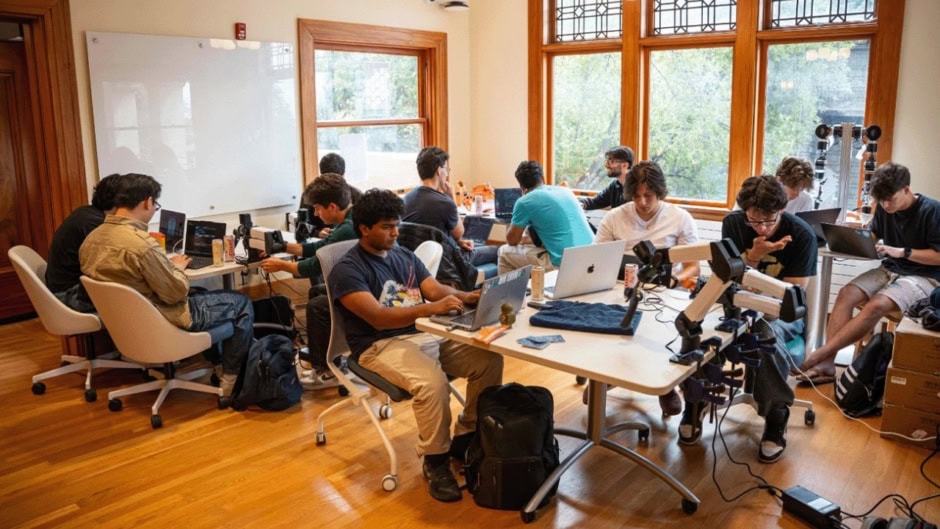
World Context, a Pakistani robotics data startup founded in January 2026, demonstrated the country’s emerging capabilities in AI and robotics by hosting its inaugural hackathon at UC Berkeley.
Thirteen teams competed using datasets from the Islamabad-based company, with a total of $4,500 in cash prizes awarded across hardware, software, and visualization tracks.
The event marks an important milestone for Pakistani technology entering US academic circles. World Context captures human demonstration data by recording workers performing physical tasks in factories, then converts those recordings into datasets used to train artificial intelligence and robotics systems. The approach leverages Pakistan’s manufacturing workforce and labor-intensive production sectors to create valuable training material for the global robotics industry.
“The talent on display at Berkeley showed how advanced the industry is in the US, and that there are tremendous opportunities to learn from and partner with US institutions and companies,” World Context founder and CEO Sherdil Ali Khan said in a statement. “We can bring these learnings back to Pakistan to improve the state of technology there as well.”
Sortbot won the hardware track with a project developing robots capable of sorting different types of objects. Reconstructors claimed both software and visualization victories, with their software category project focused on recreating World Context data in physical environments and their simulation technology taking the visualization award.
The hackathon, held in partnership with UC Berkeley student organization Blockchain at Berkeley, received sponsorship from Google Gemini, ElevenLabs, The Hackathon Company, Lovable, Praxis Robotics, and UC Berkeley Startup. The event underscores growing interest in Pakistani technology ventures among US institutions.
World Context collects data from approximately 8,000 workers in Pakistan across textile, automotive, and logistics sectors, using proprietary sensors, wearable gloves, and head-mounted cameras to capture hand movements, finger motions, and pressure applied during repetitive work. The company sells these datasets to robotics companies operating in the United States and China.
Pakistan’s manufacturing sector represents significant potential for this data collection model. Manufacturing accounts for 14.8% of overall employment in Pakistan and 20.7% of urban employment, according to the Pakistan Labour Force Survey 2024-25.
World Context selected UC Berkeley for the hackathon specifically because of the university’s strengths in robotics and engineering. Khan noted that student projects using the company’s datasets demonstrated applications the company itself had not anticipated, validating the robustness of the human demonstration data.
The company plans to host similar hackathons at other universities while exploring deeper academic partnerships as it continues scaling operations.