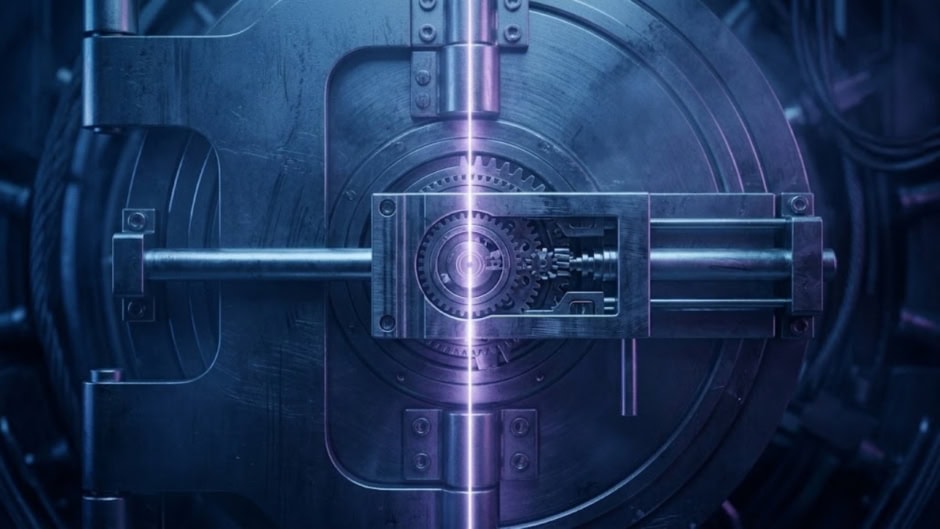
Researchers at Tsinghua University in China have built a nuclear clock that runs about six times more steadily than a competing system in Vienna. The study, led by physicist Shiqian Ding, appeared in Nature on October 7. It also marks a key step toward proving that nuclear clocks can produce reproducible results across independently made devices.
Unlike atomic clocks, which track changes in electron energy states, nuclear clocks instead measure a transition inside the atomic nucleus itself. The Tsinghua team used thorium-229 nuclei embedded in calcium fluoride crystals smaller than a grain of rice. Each crystal holds roughly one quadrillion thorium nuclei. To drive the transition, cadmium vapor heated to 1,112°F produces ultraviolet light, which then enters the crystal and excites the nuclei.
The team tested two separately produced crystals and found they gave nearly identical signals. Their frequencies agreed to roughly three parts per 10 trillion. This result therefore matters because it shows the crystal environment does not unpredictably shift the nuclear frequency. Consequently, each device would not need its own calibration. As Ding said:
A solid-state nuclear clock could potentially be made much more compact, robust and easier to operate. If that becomes possible, it could bring optical-clock-level precision out of specialized laboratories and allow such precision to be deployed much more broadly in the real world.
The Vienna system, by contrast, compares its signal with an atomic clock over six miles of optical fiber. However, its readings shifted with the laser’s path through the crystal, which in turn caused small daily timekeeping differences. The Tsinghua team avoided this issue by using a more powerful laser and a crystal with a lower thorium concentration.
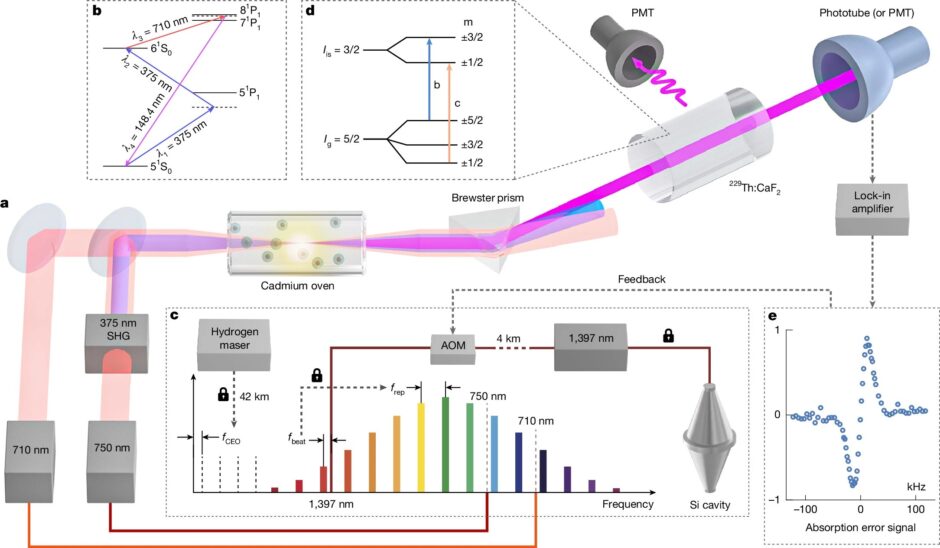
Neither clock yet outperforms the best atomic clocks, which currently support satellite navigation and global communications. However, nuclear clocks could eventually offer advantages in testing fundamental physics. Scientists could, for instance, compare nuclear and atomic clocks to search for tiny changes in physical constants. The Vienna team already used its clock for a dark matter search but found no evidence.
Thorium-229 remains extremely scarce, which still limits how many labs can run these experiments. Better crystals with more even thorium distribution and fewer defects could further improve performance. Meanwhile, the Vienna team has patented a design for a chip-sized clock and aims to shrink its prototype from lab-sized to shoebox-sized for uses such as data center server racks.
You can read the research paper here.