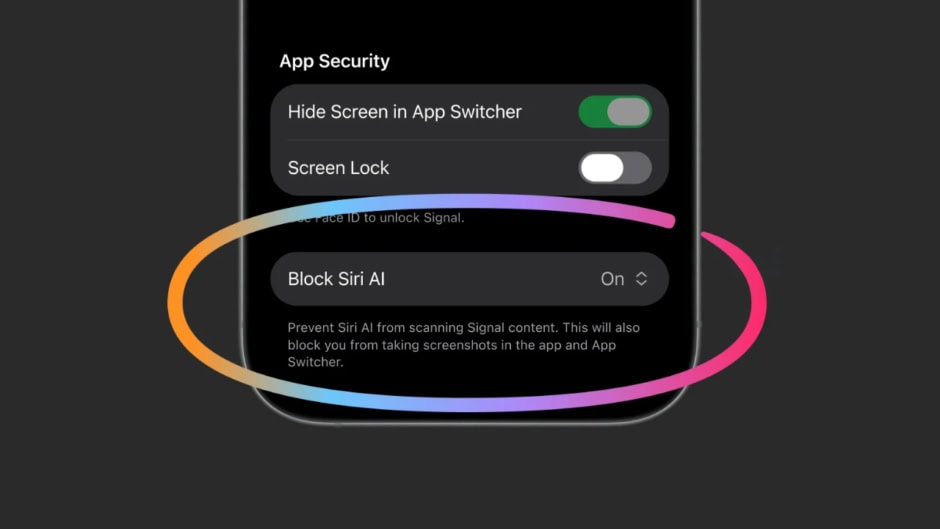
Signal is now blocking screenshots on both Android and iOS. The encrypted messaging app announced the restriction on Friday, calling AI agents embedded in operating systems an “existential threat” to private communication.
Signal president Meredith Whittaker wrote in a blog post that Windows, Android, and Apple’s macOS and iOS are all integrating agentic AI systems that can scan on-screen content. That capability, she argued, directly undermines Signal’s ability to guarantee privacy. “Your sensitive data is being captured, stored, and made accessible to whatever local database or remote server an OS-level AI agent is using at that moment,” she wrote. “All of this is outside of Signal’s control once the data has been captured.”
The move extends a fight Signal started in May 2025, when it blocked Microsoft’s Recall feature on Windows. Recall takes a screenshot of the user’s screen every few seconds and feeds the data to an AI model for search. Signal responded by applying a DRM flag to its Windows app, similar to how Netflix prevents viewers from screenshotting shows. That setting shipped as enabled by default for all Windows 11 users.
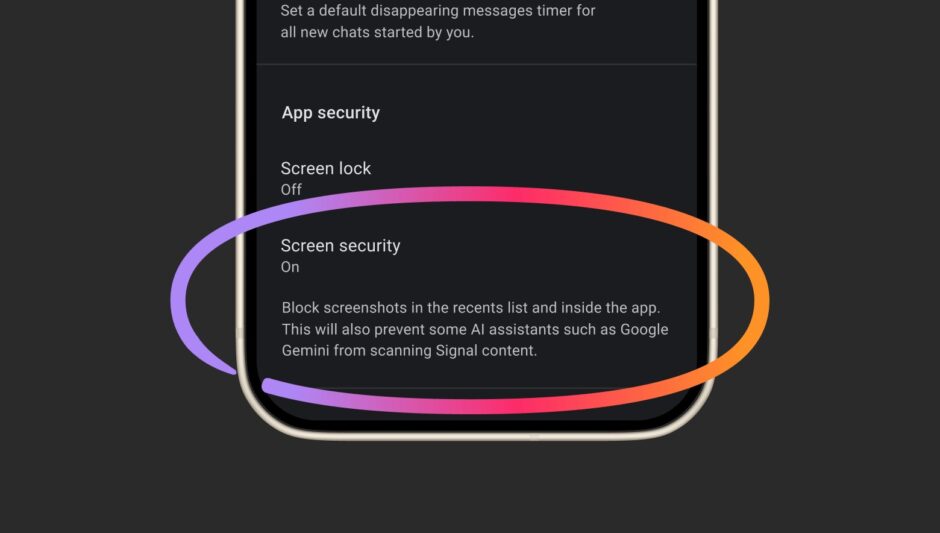
Now Signal is bringing the same approach to mobile. On Android, the Screen Security feature displays a blue privacy screen with the Signal logo whenever someone attempts a screenshot. On iOS, the equivalent feature hides the app’s content in the app switcher. Both settings will restrict the ability to capture chat content while the app is active.
However, the restriction is not absolute. Users can disable the setting in their privacy preferences if they choose. Whittaker acknowledged that doing so would “break our privacy guarantees.” She also admitted the solution is “incomplete,” since it does not address other ways AI agents could potentially access application data beyond screenshots.
Whittaker has escalated her warnings about agentic AI throughout 2026. In January, she told Bloomberg at Davos that AI agents with root access permissions were “perilous” for secure applications.
At the TechBBQ conference in Copenhagen, she went further, describing AI integration into operating systems in blunt terms. She warned that asking an AI assistant to summarize screen content triggers a screenshot of whatever app is in the foreground, including Signal.
“We will not be able to make privacy promises that we as developers who are independent can keep,” she said, “because the water we swim in will have been poisoned.”
The timing also follows an earlier report TechJuice covered that exposed how Meta’s Muse AI assistant read encrypted Signal messages through Android push notification permissions. Signal’s president called Meta’s approach “technologically reckless” in response to those findings. Apple subsequently tightened access controls in macOS 27.3 beta 2 after separate reports showed Muse reading iMessages through Full Disk Access.
The blog went on to conclude as:
Finally, we want to acknowledge that we are not the only ones recognizing these perils, and we are grateful to our allies for pushing for similar changes. We all need to recognize that the current integration of AI agents into the operating system, without these common-sense remedies, represents an existential threat to privacy at the application layer, and the ability of independent developers like Signal to protect your sensitive data. Signal is the canary in the coal mine, but this affects the entire ecosystem and should galvanize anyone who cares about these fundamental rights.
Signal urged operating system providers to give app developers proper tools to block AI-level access to sensitive data. “It’s ultimately up to companies like Microsoft to ensure that their platforms remain a suitable foundation for privacy-preserving applications like Signal,” the company wrote.
The screenshot restriction is rolling out now through the latest Signal updates on both Android and iOS.