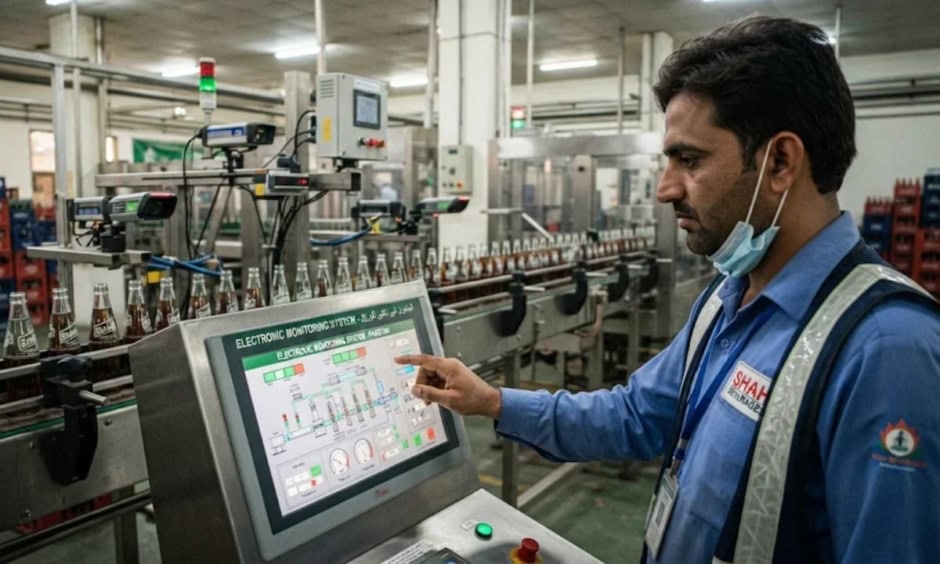
The Federal Board of Revenue (FBR) has approved seven additional vendors to supply, install and maintain electronic monitoring systems at factories producing beverages, bottled water, packaged juices and milk, enabling tax officials to track output remotely and detect possible tax evasion.
FBR Chairman Rashid Mahmood Langrial issued Sales Tax General Order No 37/2026 approving the vendors. The order supplements Sales Tax General Orders No 3, 4, 6 and 7 of 2026 and takes immediate effect.
The newly approved vendors are the National Radio and Telecommunication Corporation (NRTC), Obsidian Technologies, Excellence Delivered (EXD) Pvt Ltd, ISSM Labelling Solutions Pvt Ltd, Toolink Pakistan Pvt Ltd, AJCL Pvt Ltd and Authentic. Manufacturers may engage any of them to install the equipment.
Under the system, electronic devices installed on production lines will automatically record the number of bottles, juice packs and milk cartons manufactured. The data will be transmitted to the computer system of FBR, allowing officials to view factory output from their offices. Tax authorities will compare the recorded figures with the production and sales declared in the tax returns and other records of the manufacturers.
Any discrepancy between recorded and declared output could trigger further scrutiny. For example, if a factory produces 100,000 bottles in a day but declares only 70,000, the FBR could seek an explanation for the remaining 30,000, including whether they were sold or held in stock.
The system will cover factories making bottled water, packaged juices, packaged milk, carbonated beverages and related products. The FBR has issued a list of 54 manufacturers, including Coca-Cola, Pepsi, Nestle, Haleeb, Engro Foods, Shezan and Qarshi. It clarified that the list is neither exhaustive nor final, and all registered manufacturers of the specified products must comply, whether or not they are named.
The track-and-trace mechanism will operate on lines similar to the monitoring system introduced in the sugar industry. Production data will be accessible to relevant sales tax and federal excise duty offices, and round-the-clock monitoring, including at FBR headquarters, is also envisaged.
The FBR expects the initiative to improve production reporting, strengthen tax compliance, identify discrepancies and potentially raise revenue.
Production figures alone, however, would not establish whether a company has paid its full tax liability, which also requires examination of sales, inventory, tax returns and applicable tax rates. The effectiveness of the system will depend on the proper functioning of the equipment, verification of electronic records and enforcement by tax authorities.