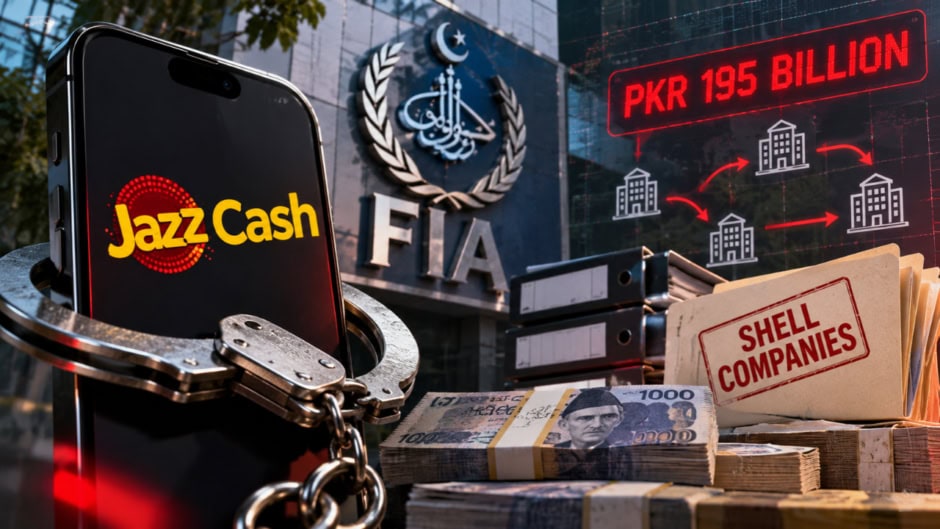
The Federal Investigation Agency (FIA) has registered a new First Information Report worth PKR 195 billion against an online gambling and money laundering (digital hawala-hundi) network that allegedly funneled billions through JazzCash accounts. This marks the second major FIA case to name Pakistan’s largest branchless banking platform in connection with illegal gambling operations.
The fresh FIR adds to an earlier case worth PKR 120 billion, bringing the combined total across both investigations to a staggering PKR 315 billion. Meanwhile, the FIA has already shut down over 100 aggregator accounts linked to the platform. These accounts reportedly generated significant revenue for JazzCash, and their closure is expected to impact the company’s earnings in the coming quarters.
Despite the scale of these allegations, JazzCash has not issued a single public statement addressing either investigation. VEON, the parent company of Jazz, recently branded JazzCash a “financial giant” in its Q3 2026 earnings report. That same report showed JazzCash posting 67.6% year-over-year revenue growth to PKR 43.4 billion, with a net profit of PKR 6.8 billion. As a result, the contrast between the platform’s commercial success and the billions allegedly laundered through its infrastructure raises uncomfortable questions.
JazzCash currently dominates roughly 70% of Pakistan’s branchless banking market. Furthermore, the State Bank of Pakistan introduced a dedicated framework in May 2026 specifically to regulate payment aggregators after the scale of these transactions became clear. The Pakistan Telecommunication Authority has also stepped in, blocking 46 gambling applications as part of a broader crackdown.
The legal pressure is mounting from multiple directions. A petition before the Lahore High Court has named international betting platforms including Betway, 1xBet, and Bet365 for allegedly using JazzCash, Easypaisa, and SadaPay to process gambling payments inside Pakistan. Additionally, the NCCIA has expanded its mandate under the Anti-Money Laundering Act, giving the agency sweeping new authority to investigate and prosecute cases involving digital financial crimes.
TechJuice reached out to JazzCash multiple times for comment on the ongoing investigations, but the company did not respond to a single request. That persistent silence from a platform processing trillions in annual transactions raises serious questions about accountability and, to some degree, suggests a level of institutional complicity in allowing these flows to continue unchallenged.
In a separate legal proceeding where Sindh High Court ordered NCCIA to halt its investigation in money laundering cases, JazzCash’s parent company has taken the position that its role is solely to provide a financial services platform to the public, not to prevent or investigate money laundering. Moreover, the petitioner’s lawyer has argued that the NCCIA lacks the legal authority to take action in this matter and has formally challenged the notice issued by the agency.
Investigators are now summoning JazzCash employees directly for questioning. Consequently, the pressure on Pakistan’s largest mobile wallet provider shows no signs of easing as regulators, courts, and law enforcement close in from every side.