
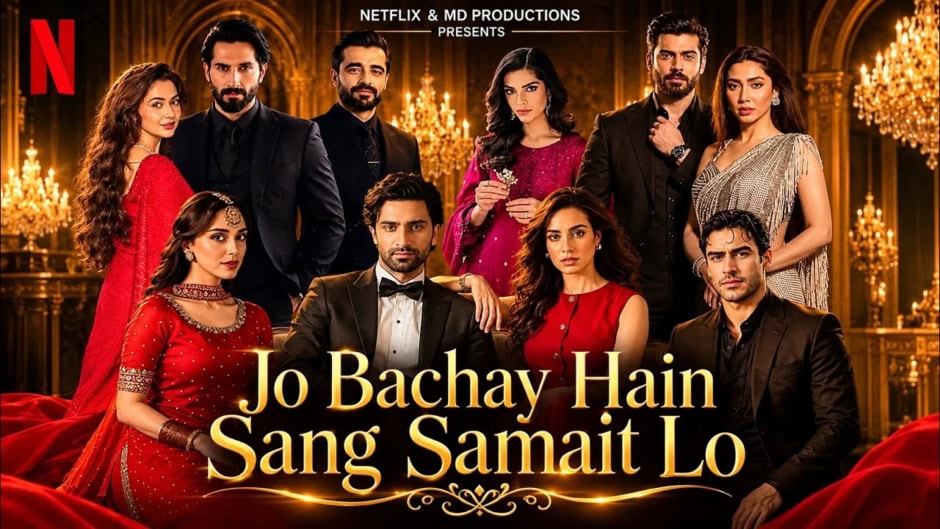
Pakistan’s first original Netflix series premiered its trailer at Mohatta Palace in Karachi on November 24. The event also unveiled the show’s official music for the first time.
Jo Bachay Hain Sang Samait Lo, titled All the Love Our Hearts Carry for international audiences, drops its first part on December 4. The Urdu-language drama spans three generations and weaves together six love stories. It draws from Farhat Ishtiaq’s bestselling 2013 novel of the same name. Momina Duraid Productions developed the project in collaboration with Netflix’s Middle East and North Africa division.
The series took nearly eight years from development to completion. Filming stretched across locations in Pakistan, Rome, and the United Kingdom. That international scope gives the production a visual canvas far wider than traditional Pakistani television dramas.

Its cast reads like a who’s who of Pakistani entertainment. Fawad Khan stars as Mehmood alongside Sanam Saeed as Victoria. Meanwhile, Mahira Khan, Hania Aamir, Ahad Raza Mir, Iqra Aziz, Maya Ali, Bilal Ashraf, Ahmed Ali Akber, and Aamina Sheikh round out the ensemble. Netflix marketing executive June Sauvaget thanked the cast in a recorded message during the Karachi event.
Fawad Khan noted that earlier Pakistani shows available on Netflix, including Humsafar and Zindagi Gulzar Hai, helped pave the way for this production. Those dramas built a loyal audience on the platform and proved demand for Pakistani storytelling at a global level.
The series also arrives at a commercially strong moment for Netflix in the region. The company told shareholders that viewing hours in India alone rose 24% year-over-year in Q3. Additionally, the title briefly appeared on Netflix’s Indian website, though the platform has not confirmed availability there.
On that front, the All Indian Cine Workers Association wrote to Prime Minister Narendra Modi demanding a block on the series. The letter cited India’s ongoing ban on Pakistani content following the May 2025 Pahalgam attack and called for a permanent law barring Pakistani productions from Indian screens. The Indian government has not responded.
Despite those tensions, watch parties for Pakistani dramas continue to draw crowds in Indian cities like New Delhi, Bengaluru, and Hyderabad. That grassroots demand suggests the appetite for Pakistani content remains strong regardless of official policy.