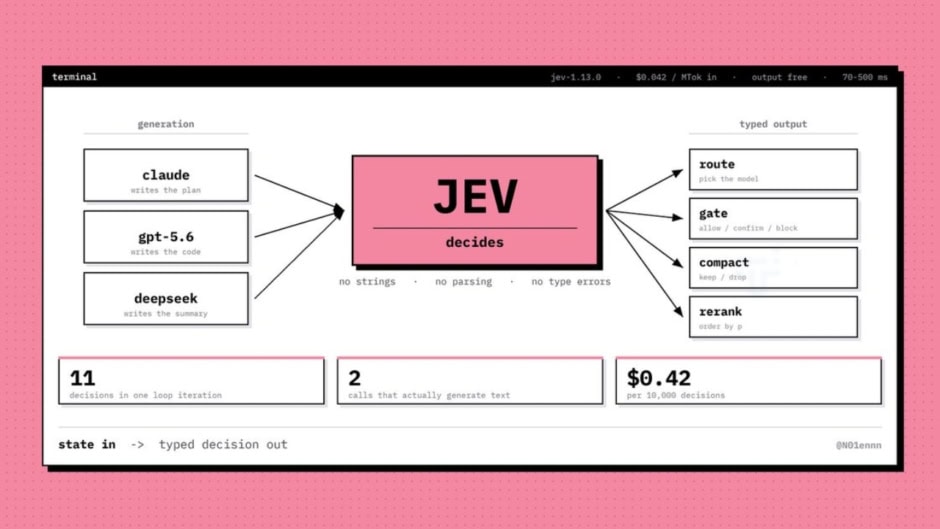
AI agents in production are burning money on the wrong tasks. Most spending never touches generation. Instead, it flows toward simple routing questions, safety gates, and scoring decisions that never needed a frontier language model.
This inefficiency is now quantifiable. Developer and researcher NO1ennn released a technical guide this week that has drawn sharp attention across AI engineering circles. The guide maps exactly where that money vanishes and proposes a concrete architectural fix.
Where Agents Waste the Most Money
A typical agent iteration contains far more decision points than generation steps. Current systems handle both with the same expensive frontier model, producing higher costs, added latency, and hallucinations on simple yes/no questions that should never have required free-text generation.
Common decision points include model routing, tool safety gating, context relevance filtering, stuck detection, worker dispatch, action selection, and completion verification. Each call costs frontier rates. Claude and GPT-4o typically charge $15 to $18 per million input tokens. Each call also adds seconds of latency and returns strings requiring parsing.
The numbers reveal brutal inefficiency. Triaging 500 emails with a frontier model costs $10 to $30. Routing a 50-decision task easily exceeds $2 to $5 per completion. For production systems processing thousands of tasks daily, costs compound into genuinely massive bills.
The Solution: Jev and the Decision Layer
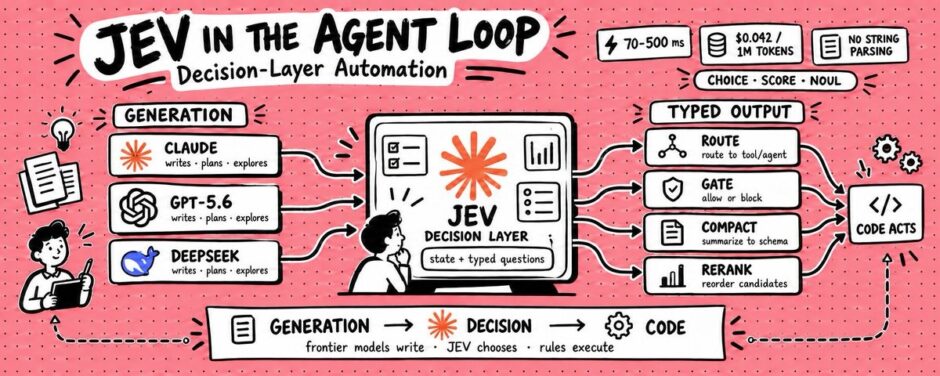
TypeSafe AI’s Jev fundamentally changes agent architecture. Rather than a general-purpose language model, Jev is a specialized “System One” model that accepts structured state plus typed questions and returns typed answers with calibrated probabilities.
It offers three primitives. Choice lets developers select from up to 255 options. Score provides numeric ratings on custom rubrics. Noul returns yes/no probabilities. Latency runs between 10 and 500 milliseconds. Pricing stands at $0.042 per million input tokens with output free. This works out to roughly 350 times cheaper than frontier models.
Jev’s architecture delivers a second advantage. Because Jev never enters the conversation history, it eliminates the “cache tax” that occurs when control returns to a frontier model forced to re-read massive context. One documented case compressed a Claude session from nearly 1 million tokens to 86,000 tokens in one second.
Concrete Impact in Production
The guide maps eleven common decision forks and their real production wins.
Classifying 1,018 research papers cost $0.08 total. Triaging 500 emails cost 3.5 cents. Browser automation tasks complete in seconds for fractions of a penny on the decision layer. One customer reduced agent cost per completion by 87% while cutting wall-clock latency in half.
Broader Implications
As AI agents move from demos into production systems, cost per task and reliability under real workloads are becoming the actual bottleneck. The emerging architecture is crystallizing. Frontier models remain responsible for planning, writing, and coding. Lightweight specialized models handle the constant stream of routing and safety decisions.
The practical advice is straightforward. Identify your single most frequent decision fork, often tool gating or next-worker selection. Move it to Jev. Then measure cost, latency, and escalation accuracy. If numbers improve, move the next fork.
For Pakistani startups building AI agents at scale, this efficiency gap matters deeply. Every dollar saved on unnecessary frontier model calls extends runway significantly.