
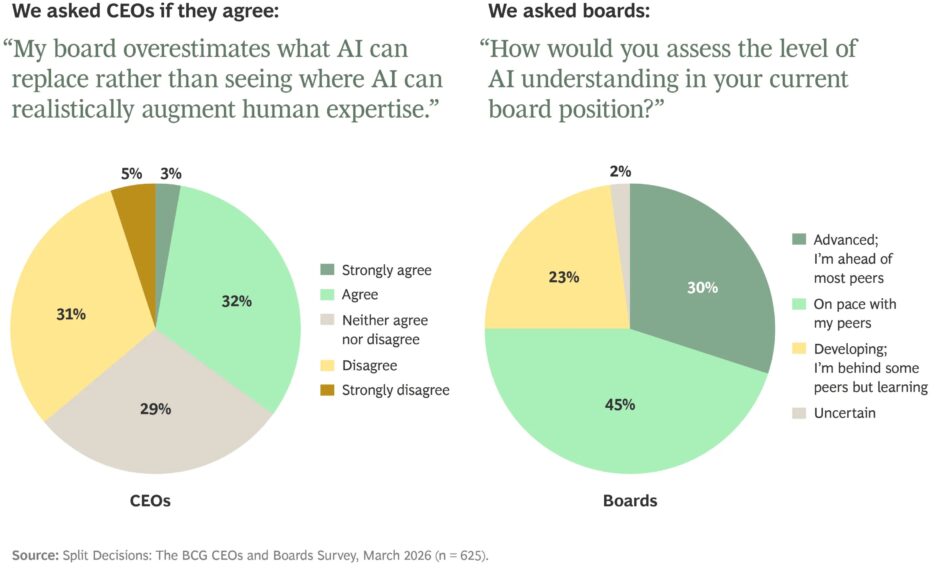
A significant gap exists between boardroom confidence and actual AI competence. BCG’s 2026 survey of 625 CEOs and board members found that 75% of directors rated their AI knowledge highly. However, nearly 40% of CEOs said their boards lack an informed perspective on how AI reshapes growth strategy.
This mismatch shows up clearly in disclosure data. The Conference Board reported in April 2026 that 83% of S&P 500 companies disclosed AI as a risk during 2025. Yet only 2.7% of board directors disclosed AI expertise by 2025, barely rising from 1.5% in 2021. Just 23% of executives surveyed described their board as highly fluent in AI.
Meanwhile, DataCamp’s 2026 literacy report found that 59% of leaders admitted AI skills gaps inside their organizations. This gap directly reduces returns. DataCamp research showed that 21% of leaders reported significant positive ROI from AI investments. That figure doubled to 42% in organizations with mature literacy programs.
However, the real differentiator is prompting discipline. Hobbyists ask chatbots to summarize reports, while leaders ask for summaries framed around specific decisions, named audiences, time budgets, and potential failure modes. This structural difference produces vastly superior output. A leader’s prompt specifies the audience, states the stakes, includes source material, and requests uncertainty flags. Hobbyists, by contrast, remain vague.
Furthermore, context engineering now outweighs prompting alone. A 2026 context management report found that 82% of IT and data leaders agree prompt engineering alone falls short. A September 2026 BARC study of 285 organizations discovered that teams with mature context engineering programs qualify as AI leaders four times more often than their peers.
Consequently, executives pull ahead by pasting actual documents instead of paraphrasing from memory. This practice lets models reason over real data. Production systems apply the same logic at scale. Long chat threads carry their own penalty because models lose track of early instructions.
Therefore, the ROI difference is measurable. CEOs estimate 35% of their performance evaluation now depends on AI ROI, according to BCG‘s May 2026 research. The personal stakes are rising. Leaders treating prompting as a core skill and practicing it daily alongside meetings gain measurable advantages over peers who treat it as an afterthought.