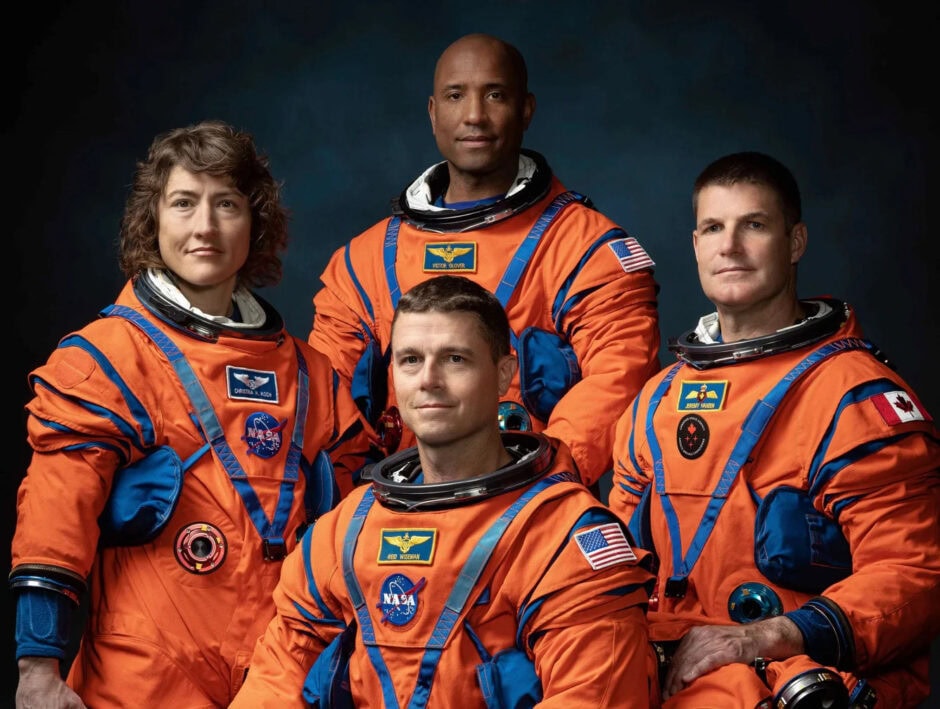
NASA launched Artemis II on April 1, 2026, sending four astronauts around the Moon on the most technology-dense crewed spacecraft ever built.
The mission lifted off from Kennedy Space Center’s Launch Complex 39B aboard the Space Launch System, a 322-foot rocket that produces about 15% more thrust than the Saturn V used during Apollo. Four upgraded RS-25 engines power the core stage. These are evolved versions of the Space Shuttle’s main engines. Two solid rocket boosters provide additional lift during the first two minutes of flight.
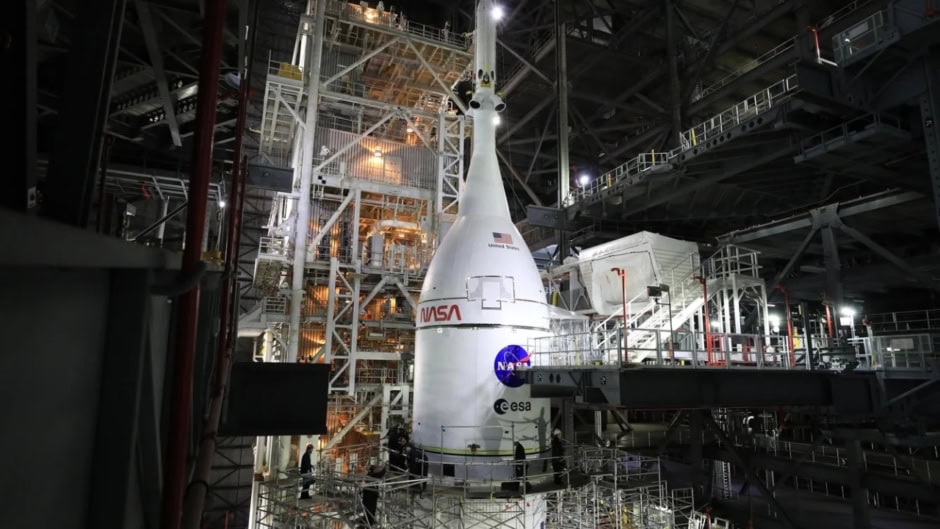
The Orion spacecraft sits at the top of the stack and is flying with a crew for the first time. It supports four astronauts for up to 21 days with life-support, navigation, and avionics systems built specifically for deep space operations. Its heat shield, the largest ever constructed, uses an ablative material called AVCOAT to protect the capsule during reentry at roughly 25,000 miles per hour. NASA revised the reentry profile after the uncrewed Artemis I flight in 2022 revealed unexpected erosion in the shield material.
The European Space Agency supplied Orion’s service module, which delivers propulsion, electrical power, water, and breathable air. Four solar array wings deploy from the module and rotate on two axes to track the Sun, generating continuous power throughout the journey.
One of the more notable systems aboard is the O2O optical communications unit. It replaces traditional radio with laser-based data transmission, sending information to ground stations in California and New Mexico at up to 260 megabits per second. The hardware includes a four-inch telescope, two gimbals, a modem, and control electronics.
On the biology side, the AVATAR experiment carries organ-on-a-chip devices containing bone marrow stem cells donated by each crew member. Built by Emulate and housed in a Space Tango payload, the chips operate autonomously using a microfluidics system that delivers nutrients and removes waste. After the crew returns, researchers will perform single-cell RNA sequencing to measure how deep-space radiation affected blood cell development at the genetic level.
Five international CubeSats also flew aboard. Germany’s TACHELES tests electrical components for lunar vehicles. Argentina’s ATENEA studies radiation shielding. South Korea’s K-RadCube measures radiation using tissue-mimicking materials.
The mission’s core purpose is validating all of these systems with humans aboard before NASA commits to a lunar surface landing on Artemis IV in 2028.