On March 9, 2026, the Pakistan Telecommunication Authority (PTA) released a detailed media brief ahead of the highly anticipated Next Generation Mobile Services (NGMS)/5G Spectrum Auction scheduled for March 10. This auction represents a critical juncture in Pakistan’s telecom evolution, promising to address longstanding bottlenecks while unlocking new economic opportunities. Drawing directly from PTA’s data on sector growth, challenges, spectrum allocation, policy reforms, network rollout, and quality benchmarks, TechJuice explores what the auction could deliver for consumers, businesses, and the digital economy. While the process has been years in the making, the numbers reveal both promising potential and persistent hurdles as Pakistan aims to leap into the 5G era.
Telecom Sector Growth: Steady Expansion Amid Rising Demand
PTA data highlights a telecom sector that has grown robustly despite constraints. From 2022–23 to 2024–25, telecom subscribers increased from 193.5 million to 205 million, with teledensity rising from 81.4% to 82%. Broadband subscribers surged from 127.6 million to 157 million, penetration from 53.6% to 63%. Data usage exploded 37% from 20,235 petabytes (PB) to 27,727 PB, reflecting a 25% year-on-year jump in 2024–25 alone. Cell sites expanded from 53,581 to 59,132, revenues from PKR 817 billion to PKR 1,075 billion, and contributions to the exchequer from PKR 341 billion to PKR 402 billion.
A key insight: Monthly data usage per cellular subscriber reached 9.3 GB, with 97% enabled by 4G. Fixed broadband usage also climbed from 8,790 PB to 16,250 PB. These figures underscore surging demand – more than 5,000 cell sites added in three years – but also strain on existing networks, where average 4G speeds hover around 4 Mbps.
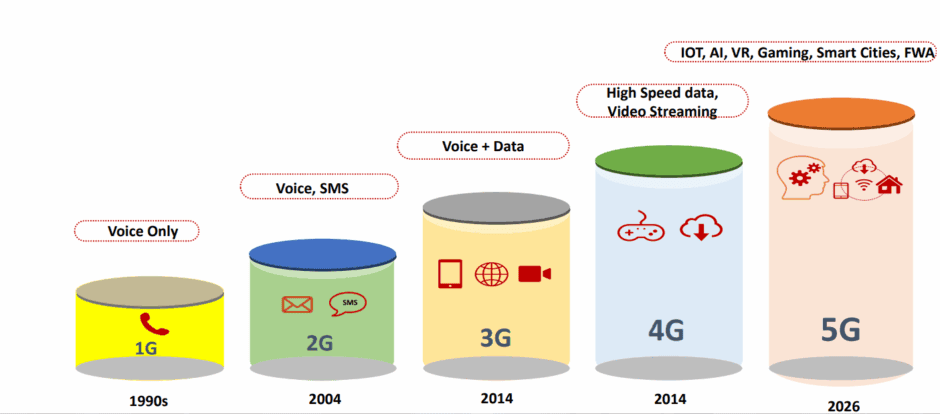
The evolution chart from PTA shows Pakistan’s mobile tech progression: 1G (1990s, voice only), 2G (2004, SMS), 3G (2014, data/video), 4G (2014, high-speed streaming), and now 5G (2026, IoT/AI/VR/smart cities/FWA). This auction could accelerate that trajectory, boosting data-intensive applications.
Key Challenges: Data Reveals Persistent Barriers
PTA’s challenge table paints a stark picture of why Pakistan lags regionally:
- Spectrum Availability: Lowest in the region.
- Delayed Auctions: Only in 2004, 2014, 2016, 2017, 2021 (just 1 CMO participated in the last 3).
- Auction Fee: USD-benchmarked, impacted by rupee devaluation.
- Payment Terms: 100% upfront or 50% upfront + 5 equal installments.
- QoS Benchmarks: 4 Mbps average since 2021 auction.
- Power Issues: Prolonged load-shedding.
- Right of Way: Exorbitant civic charges.
- Network Rollout: Approx. 445 sites.
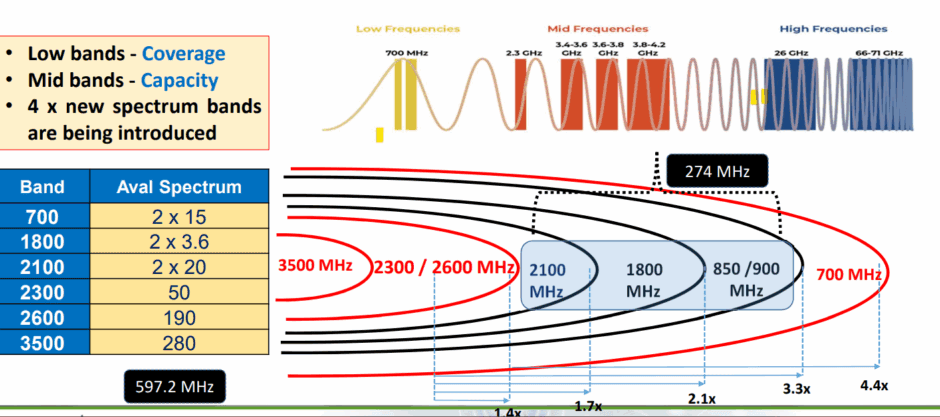
The spectrum bands chart shows Pakistan’s current allocation at 597.2 MHz post-auction potential, with low bands (700 MHz) for coverage, mid (1800–2600 MHz) for capacity, and high (3500 MHz) for speed. Pre-auction, Pakistan ranks low regionally; post-auction, it could jump 1.4x–4.4x in allocation, per PTA’s expected outcome graphs.
What’s Being Auctioned: Spectrum Details and Pricing
The auction offers 597.2 MHz across six bands:
- 700 MHz: 2×15 MHz at $6.5 million/MHz.
- 1800 MHz: 2×3.6 MHz at $14 million/MHz.
- 2100 MHz: 2×20 MHz at $14 million/MHz.
- 2300 MHz: 50 MHz at $1 million/MHz.
- 2600 MHz: 190 MHz at $1.25 million/MHz.
- 3500 MHz: 280 MHz at $0.65 million/MHz.
Payments in PKR at SBP rate, with a 1-year moratorium and flexible terms (100% or 50% upfront + 5 installments at KIBOR + 3%). Technology-neutral, allowing 4G/5G use. Three bidders qualified: Jazz (PMCL), Zong (CMPak), Ufone (PTML), ensuring competition.
Policy Reforms: Data on Incentives and Support
PTA’s salient features table outlines reforms to spur adoption:
- Fixed PKR/USD rate on auction date.
- 1-year moratorium on payments.
- Enabling smartphone upgrades via tax reductions.
- Promotion of local manufacturing for affordability.
- Duty-free 5G equipment import.
- JTF (MoIT&T, MoE, NEPRA, PTA, operators, DISCOs) for industrial power tariffs, smart grids, dedicated feeders to combat outages.
These aim to address data-highlighted challenges like power issues and costs, fostering a supportive ecosystem.
Network Rollout: Phased Data-Driven Obligations
Operators face a 9-year phased rollout:
- Annual site build-out: 1,000/operator/year (200 for coverage gaps).
- 5G Coverage: Federal/provincial capitals (2026–2027), +10 cities (2/province, 2028–2029), +10 (2/province, 2030–2031), +15 (3/province, 2032–2035).
- FTTS Ratio: 20% (2026–2027), 25% (2028–2029), 30% (2030–2031), 35% (2032–2035).
- 4G enhancement: Urban/rural proportionate.
- Coverage maps for transparency.
This structure, per PTA, ensures 5G starts in major cities mid-2026, expanding gradually.
Quality of Service: Benchmark Data and Enhancements
PTA’s QoS table shows phased improvements (nationwide, median measurement):
- 4G: DL from 20 Mbps (2026–2027) to 50 Mbps (2030–2035); UL 20% of DL; latency ≤75ms to ≤50ms; web loading ≤5s to ≤3s.
- 5G: DL from 50 Mbps (2026–2027) to 100 Mbps (2030–2035); UL 20% of DL; latency ≤50ms to ≤35ms; web loading ≤5s to ≤3s.
- New KPIs: Network downtime at district/tehsil/union council levels.
These benchmarks tie to licenses, promising 5x 4G rate enhancement and transformative 5G latency for real-time apps.
Expected Outcomes: Economic and Sectoral Data Projections
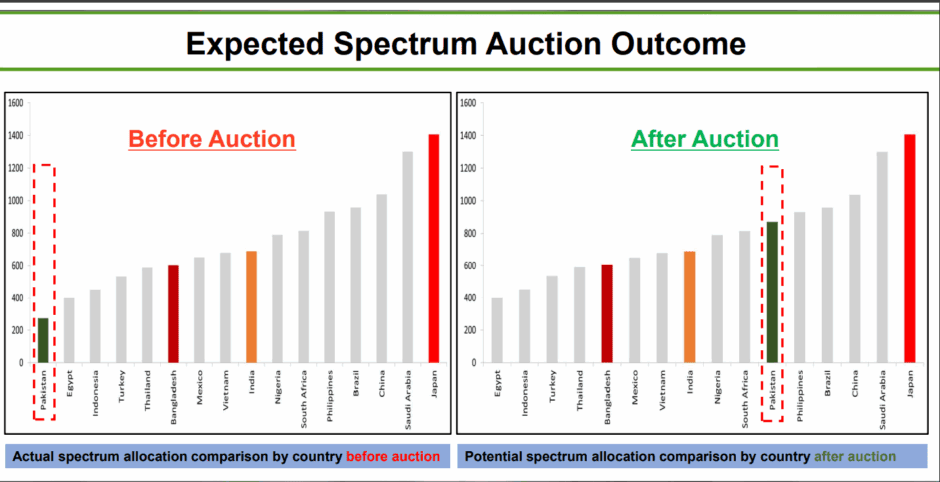
Post-auction, PTA’s outcome charts show Pakistan’s spectrum allocation jumping regionally, potentially enabling:
- IT Exports: Jul–Dec FY26 at $2.23B (+19.5% YoY), December $437M; from <$1B (late 2010s) to >$3B (2024). 5G could accelerate this by enhancing reliability for software houses/freelancers.
- Startups: Healthtech (telemedicine), edtech (synchronous learning), e-commerce ($14B market projected), fintech (15B digital transactions goal by June 2026), IoT/smart cities/industrial automation.
- Broader Economy: Revenue ~$700M (estimated), fiscal relief for IMF/creditors, competitive edge vs. India/Bangladesh/Vietnam.