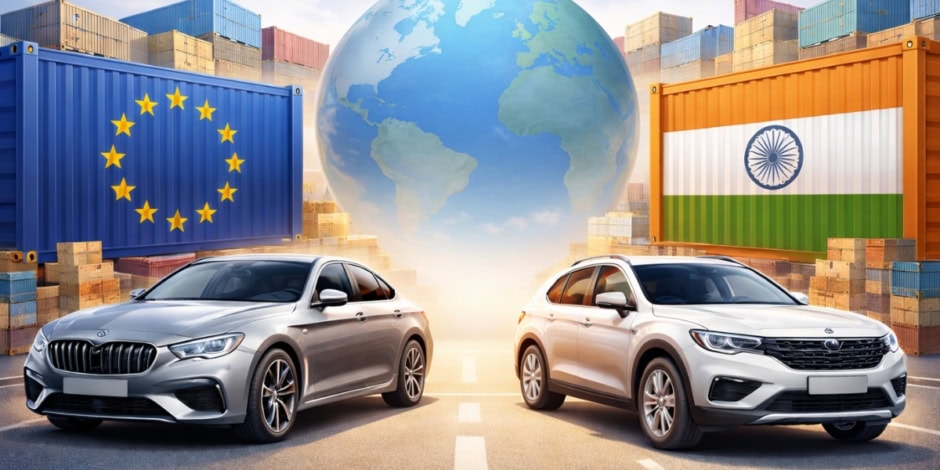
India and the European Union (EU) officially signed a landmark Free Trade Agreement (FTA) on Tuesday, January 27. This EU-India FTA, described as the “mother-of-all deals”, dramatically lowers tariffs and opens vast markets for businesses on both sides.
Both parties also adopted a joint strategy document, “Towards 2030 – A Joint India-European Union Comprehensive Strategic Agenda”, to guide cooperation for the next decade.
Tariffs Slashed for Exporters & Major Shift in Auto Sector
This agreement offers immediate relief to Indian exporters. Upon launch, the EU will scrap tariffs on 90% of Indian goods. This coverage expands to 93% within seven years. Consequently, the EU’s average tariff rate on Indian goods will plummet from 3.8% to just 0.1%.
Labour-intensive sectors stand to gain the most. Tariffs will fall to zero for:
- Textiles and apparel
- Gems and jewellery
- Chemicals, plastics, and rubber
- Marine products
- Leather and footwear
In return, India will reduce tariffs on EU goods to zero on 93% of bilateral trade value over ten years.
The automobile sector sees a massive restructuring. Taxes on EU-made cars will drop from the current 110% to 10% over five years.
However, the deal includes specific caveats:
- Exclusions: EU cars priced below €15,000 ($17,800) get no tax cuts.
- Tiered Approach: Tariffs on most eligible cars start at 30–35% and fall gradually.
- EVs: Tariff cuts for electric vehicles only begin in year five.
Furthermore, these reductions apply only to quotas. No duty cuts apply to CKD (Completely Knocked Down) kits.
Services & Digital Trade
The FTA significantly boosts the services sector. India gains access to 144 EU service subsectors, while the EU gains access to 102 Indian subsectors. Crucially for the tech industry, this includes IT, financial services, and professional services.
Digital trade provisions are also included. These aim to support business growth while strictly protecting privacy and security. Additionally, new frameworks now support business mobility and student exchanges.
EU-India FTA Exemptions: Steel & Agriculture
Despite the broad scope, three sensitive sectors face calibrated protections:
- Steel: Steel remains outside full tariff elimination due to strategic concerns. However, India is seeking improved access to tariff-free quotas, with results expected by June 30.
- Carbon Tax: India did not receive an exemption from EU carbon duties. Instead, a technical group will verify carbon footprints.
- Agriculture: India successfully safeguarded sensitive items like dairy, poultry, cereals, and soymeal.
Conversely, Indian tariffs on EU agri-food imports will drop. Duties on premium wines will fall from 150% to as low as 20%.
Commerce Minister Piyush Goyal and EU Trade Commissioner Maros Sefcovic signed the political declaration, marking one of the deepest market-access agreements India has ever signed with a developed economy.