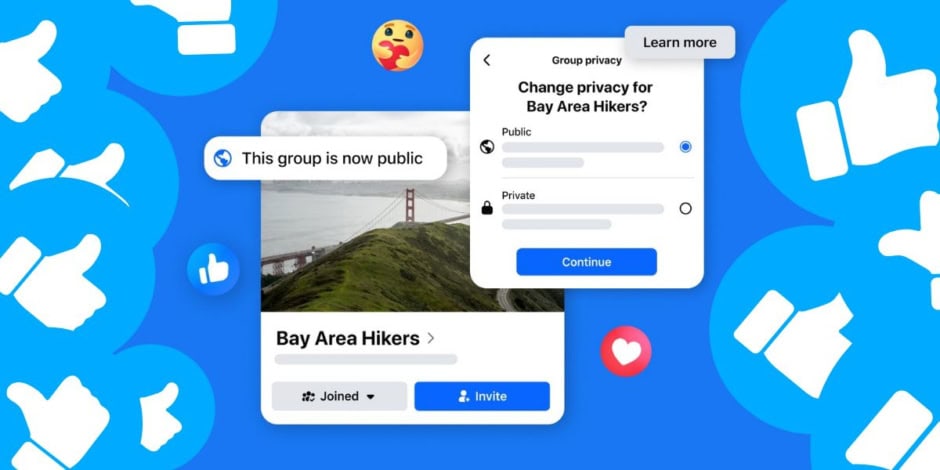
Meta has announced a key change to how Facebook groups can operate. Group administrators will now be able to convert private groups into public ones, expanding their reach to wider audiences but also raising new questions about privacy, control, and community trust.
What’s Actually Changing And Why It Matters
Under the new policy, group admins can now switch a group’s classification from private to public directly through settings.
According to Facebook:
We’re helping Facebook Group admins grow their communities by giving admins the option to change their group from private to public while still protecting member privacy.
We know that group admins want more tools to grow and manage their communities, and we’re listening to your feedback. Today, we’re starting to roll out a new update that gives private group admins the option to change a group from private to public. This unlocks new opportunities for growth and connection while keeping member privacy and previously shared content protected.
Once the switch is initiated, the group will automatically notify all its members. They’ll then have a three day review window before the conversion takes effect.
When a group becomes public, all new posts become visible to non members, while older content remains accessible only to those who were already members before the switch.
Facebook clarified that member lists remain hidden, even after the transition, ensuring some continued privacy for those inside the group. A subtle but important visual cue will also appear, a globe icon next to posts, signaling that the content is now visible to everyone.
The Big Picture for Community Managers
The change now gives group admins unprecedented flexibility but also new challenges to navigate. Making a group public dramatically improves discoverability across Facebook’s ecosystem. Public groups are more likely to appear in recommendations and search results, meaning faster growth and more organic engagement. It also removes friction from recruitment. New users can join discussions instantly, without waiting for admin approval, opening the door to larger, more dynamic communities.
Yet, this newfound openness comes with its own price. Once a group becomes public, the expectation of privacy disappears. Members who joined under private terms may suddenly feel exposed, triggering confusion or mistrust.
Admins must also be prepared for content moderation at scale. Public groups tend to attract spam, misinformation, and off topic chatter, all of which require stricter oversight and clear posting rules.
How to Navigate the Shift Successfully
If you’re an admin or community lead, here’s how to prepare before making the transition.
Clarify your purpose. If your goal is community growth, exposure, and open dialogue, going public may be the right move. But if your members rely on privacy or mutual trust, remaining private could preserve your community’s essence.
- Listen before acting: Announce your intent and gather feedback from members and moderators. This not only builds transparency but can also reveal concerns you hadn’t considered.
- Communicate early and often: Share a post explaining exactly what will change, emphasizing that old posts remain private, while new posts will be public.
- Strengthen your moderation game: Public groups require more active moderation. Be ready to handle spam, trolling, and unwanted content with clear policies and consistent enforcement.
Why Meta Is Doing This Now
This move fits into Meta’s broader mission to reinvigorate engagement on Facebook through community driven spaces. For years, private groups have powered some of the platform’s most loyal and active audiences, from parenting networks to local buy and sell circles.
By allowing those spaces to go public, Meta is effectively encouraging creators, brands, and community leaders to bring more conversation into the open, feeding the company’s larger ecosystem of discoverable, monetizable content.
Facebook notes that if the experiment doesn’t work, groups can revert to private settings, though rebuilding trust afterward might be harder than flipping the switch.