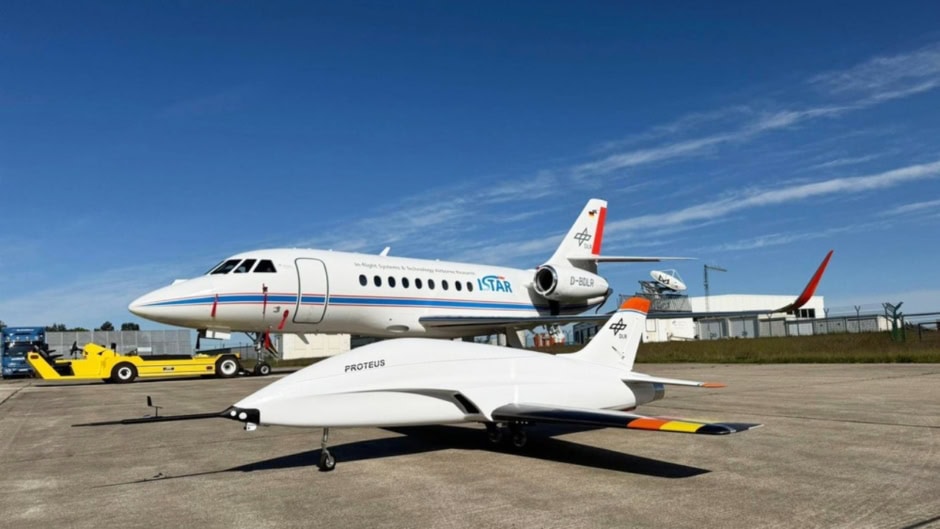
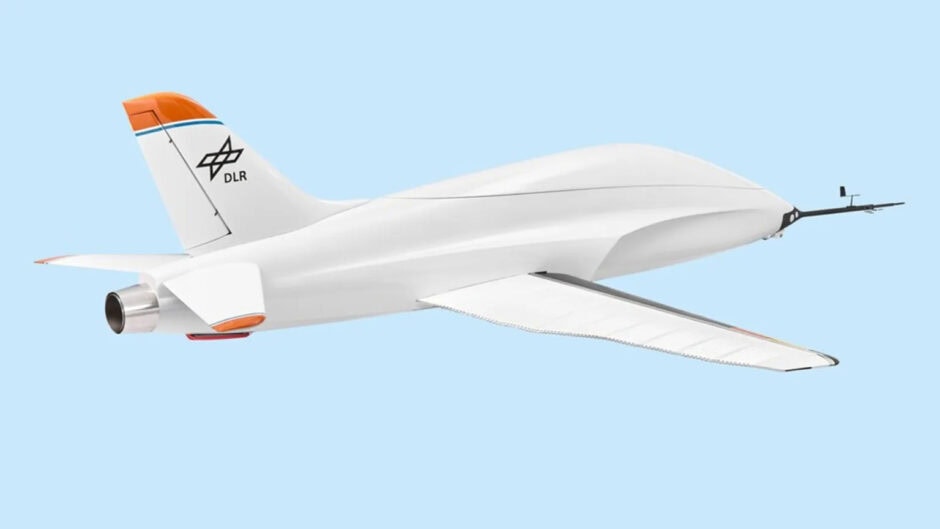
German engineers successfully tested aircraft wings that physically change shape during flight to match changing conditions, making aircraft more efficient, safer and easier to control. The German Aerospace Center conducted trials in April 2026 using its uncrewed experimental aircraft PROTEUS.
The German Aerospace Center, one of Europe’s largest engineering and science research institutions, tested the system under its morphAIR project. Scientists equipped the PROTEUS with both conventional and morphing sets of wings. The trials occurred at the National Experimental Test Center for Unmanned Aircraft Systems in Cochstedt.
Martin Radestock from the DLR Institute of Lightweight Systems leads the project. He explained that the morphing wing can change its shape during flight, allowing it to adapt optimally to different flight conditions. The project focuses on developing wings that can adapt their shape continuously in the air.
Both wing sets are made entirely of fiber-reinforced composites. The morphing wing pair features a flexible trailing edge section enabled by a Hyperelastic Trailing Edge Morphing system called HyTEM. This allows the wing to deform seamlessly without steps and respond dynamically to turbulence, airflow and changing conditions.
Radestock stated that HyTEM replaces conventional flaps and ailerons with several small actuators distributed across the wingspan. These actuators can precisely adjust the wing profiles at ten points without creating gaps between sections. The continuous shape reduces profile drag while allowing lift, induced drag and aircraft control to be influenced in a targeted manner.
Besides greater efficiency, this technology promises improved safety. Control functions can be distributed across the entire wing, providing fault tolerance if individual actuators fail.
A central element of the project is an AI-assisted flight control system developed by the DLR Institute of Flight Systems. The system makes full use of the unique movement capabilities of the morphing wing. During flight, the adaptive algorithm detects when the aircraft behaves differently than expected and continuously updates its internal models.
During development, researchers simulated failure scenarios. This allowed the system to learn how to maintain stable flight even when parts of the wing were compromised. Unlike conventional flight control systems, this adaptive approach can optimally coordinate the many distributed actuators, making the most of the aerodynamic potential while improving fault tolerance.
The team developed a method to reconstruct surface pressure distribution using only a small number of sensors. This capability, created by the DLR Institute of Aerodynamics and Flow Technology, gives the system an immediate sense of its current flow field.
The experimental aircraft can compare the reconstructed pressure field with the expected state, automatically detect local deviations and interpret them as relevant disturbances. This allows the system to respond immediately to changing conditions.
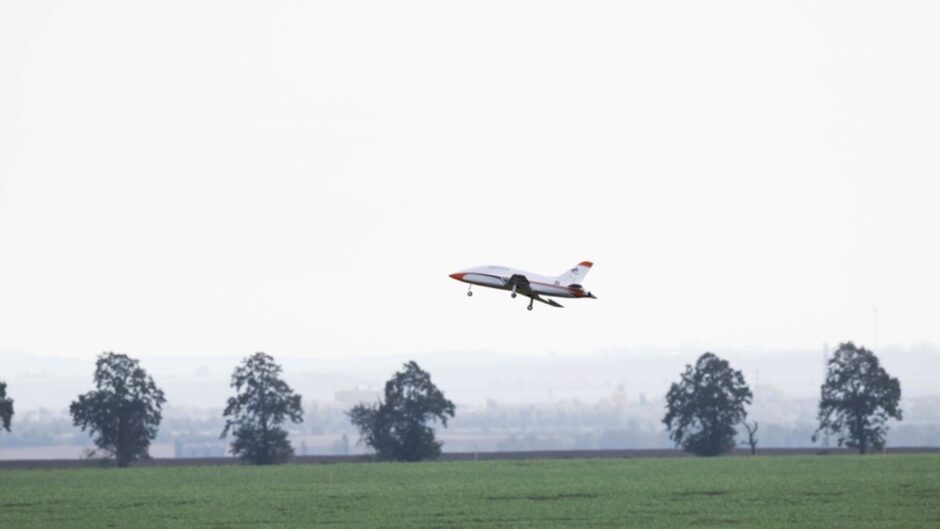
Initial trials successfully tested both wing concepts in flight. Researchers integrated both the reference wings and the newly developed morphing wings into the aircraft and tested them. The trials primarily demonstrated basic airworthiness and system integration, forming an important foundation for further measurement campaigns.
The aerodynamic and structural design features a maximum speed of 300 kilometers per hour (186 miles per hour) and wing loading of 70 kilograms per square meter (14.3 pounds per square foot). While tested in scaled form, the design remains relevant to light aircraft.
A further flight test campaign is planned during 2026 using PROTEUS with a total mass of around 70 kilograms (154 pounds) to demonstrate scalability. The findings will be taken forward in the Unmanned Aircraft Wing Adaption project called UAdapt.
The concept of morphing wings is not new. The Wright brothers used wing warping for lateral control in their early aircraft. Birds visibly use wing warping to achieve control, which significantly influenced early aircraft designers.
However, traditional wing warping designs involved flexing of structural members, making them difficult to control and liable to cause structural failure. Ailerons replaced wing warping as the most common means of achieving lateral control by 1915. Modern technology has now allowed scientists to revisit the concept with advanced materials and AI control systems.
NASA and MIT also developed morphing wings in 2019. Their design assembled wings from tiny subassemblies into a lightweight lattice framework covered with a thin polymer layer. The wing automatically responded to changes in aerodynamic loading conditions through a self-adjusting, passive wing-reconfiguration process.
The German approach differs by using active AI control and distributed actuators rather than passive self-adjustment. This allows for more precise control and adaptation to varying flight conditions.
Adaptive or morphing wings could provide significant increases in performance, including fuel savings, longer range and reduced noise. Different wing shapes could also assist aircraft experiencing changes in weight and weight distribution as fuel is used during flight.
The technology shows particular promise for unmanned aerial vehicles, which can make maneuvers without regard to pilot safety and are small enough to maintain structural integrity during shape changes.