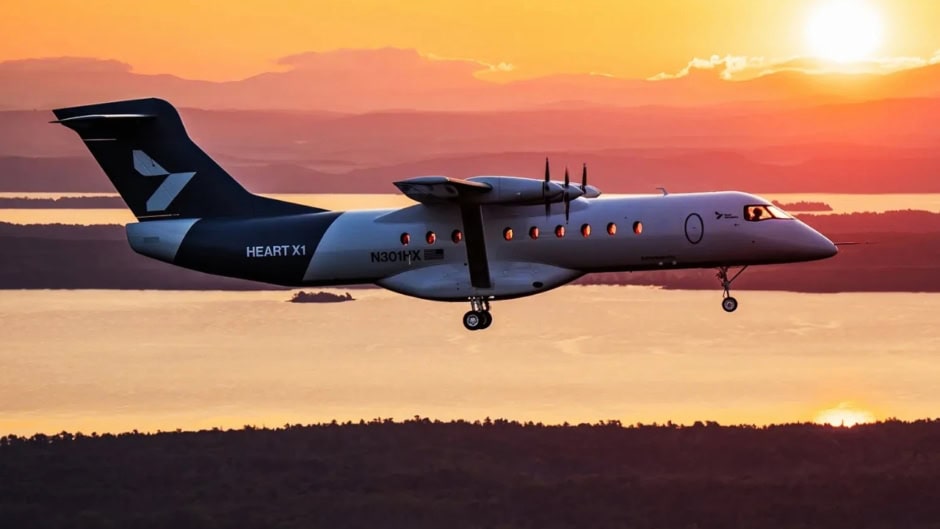
On August 12, Heart Aerospace marked a major aviation breakthrough. Operating out of Plattsburgh International Airport in northern New York, the Swedish firm’s X1finished a 27-minute maiden flight. X1 is the globe’s biggest battery-powered plane, and it has a sole pilot. The breakthrough was achieved at a height reaching up to 1,100 feet, demonstrating that electric engines are viable for commercial-sized aircraft.
The X1 features a 106-foot wingspan, measures 76 feet from nose to tail, and tips the scales at over 25,000 pounds when lifting off. Its fully electric drive system generates upwards of one megawatt. Crucially, the entire trip used about $5 worth of juice. This arrives during a persistent spike in aviation fuel costs, which hit $3.50 per gallon on average for the week concluding August 7, which is a 63% annual jump. That financial contrast is significant: for local and regional flights, electric power is vastly cheaper than jet fuel.
Through its Mesa Airlines division, United Airlines has reserved 100 planes alongside 50 options, Air Canada has purchased 30, and JSX has filed a letter of intent for as many as 100 units. Big carriers investing in funding before the X1 ever took off is a major promising gesture. Additional carriers like SAS, Icelandair, Loganair, Braathens Regional Airlines, Sevenair, and Sounds Air have signaled firm interest in securing the ES-30 model.
The X1’s success is significant because scaling up has historically doomed past electric flight projects. While battery-powered planes have existed for over fifty years, they typically failed to transition from single-seat novelties to heavy commercial standards. The X1 breaks past that barrier. Operating under an experimental FAA Special Airworthiness Certificate, the test run covered taxiing, takeoff, ascent, aerial maneuvers, and touchdown.
It’s worth noting that the X1 itself is not the final commercial product. Instead, the testbed confirms systems for the company’s ES-30, a 30-passenger hybrid-electric regional liner built for a 200-kilometer purely electric reach, extending to 800 kilometers in hybrid mode.
Heart Aerospace aims for a 2031 launch date. The business still confronts strict certification processes, battery material bottlenecks, and the need for airfield charging grids. No firm has ever successfully certified and mass-produced an electric airliner, and Heart is half a decade away from attempting it.