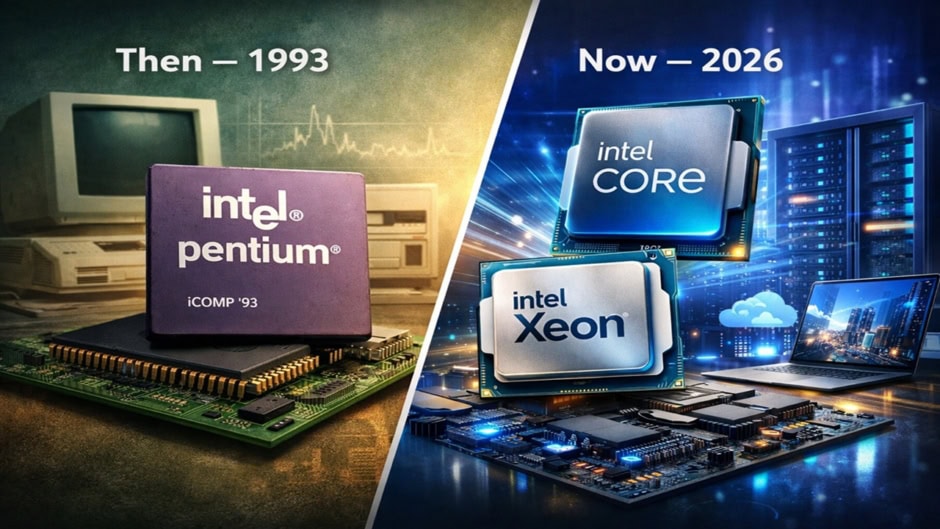
March 22, 1993, marked a defining moment in personal computing. Intel officially launched the Pentium processor, a revolutionary chip that redefined PC performance, efficiency, and capabilities. This launch was more than a hardware upgrade; it was a turning point that accelerated the adoption of personal computers globally and shaped modern computing.
Early Emergence
The early 1990s were a critical period in computing. Intel’s 386 and 486 processors had already set the stage for more capable PCs, but as software became increasingly complex, especially multimedia applications, CAD programs, and gaming demand for higher performance grew rapidly.
Intel responded with the Pentium, which introduced superscalar architecture, allowing it to process multiple instructions per clock cycle.
Other Notable Innovations Included:
- 64-bit data bus – allowed faster data transfer between the processor and memory.
- Enhanced floating-point unit (FPU) – greatly improved performance for graphics, scientific computations, and 3D modeling.
- On-chip cache memory – reduced latency and improved speed for frequently accessed data.
- Dual pipeline design – enabled simultaneous instruction processing, boosting overall efficiency.
These advancements made the Pentium far superior to its predecessors in both speed and versatility.
Intel Corporation- 1968
Intel Corporation, founded in 1968 by Robert Noyce and Gordon Moore, had already earned a reputation for innovation in microprocessor technology. The Pentium was the product of years of research and collaboration among Intel engineers, including the legendary John H. Crawford, who played a critical role in developing its architecture.
The name “Pentium” was chosen to signify the fifth generation of Intel’s x86 processors while also providing a distinctive brand name that could be trademarked, a smart marketing move that reinforced Intel’s dominance in the CPU market.
How Pentium Gained Attention
The Pentium’s launch generated massive media coverage and consumer interest. Its superior speed made PCs capable of running advanced software, including multimedia programs, desktop publishing tools, and early 3D games, transforming how people worked and played on computers.
Intel also partnered with PC manufacturers like Dell, Compaq, and IBM, ensuring the Pentium reached a wide audience quickly. Early benchmarks and tech magazines praised the processor for impressive clock speeds (60-66 MHz initially), reliability, and multitasking capabilities, further cementing its reputation.
Market Impact
The Pentium processor was a commercial and technological success. It quickly became a standard for business and home PCs, driving PC sales worldwide. Its performance enabled software developers to create more sophisticated applications, ultimately contributing to the growth of the software industry. Intel also used the Pentium to solidify its position against competitors such as AMD, setting the stage for decades of CPU innovation.
Why It Still Matters Today
Even in 2026, the legacy of the Pentium lives on. Modern CPUs, including Intel’s latest Core and Xeon processors, are direct descendants of Pentium architecture. Concepts like superscalar pipelines, on-chip cache, and floating-point acceleration remain fundamental to CPU design.
The Pentium also played a key role in making PCs accessible and useful for a wide range of applications, from gaming and education to business and creative industries.
Then vs Now
In 1993, the original Pentium processors ran at 60-66 MHz, were single-core, featured only 16-32 KB of L1 cache, and often struggled with heavy multitasking or graphics-intensive applications.
Fast forward to 2026, modern processors boast clock speeds exceeding 5 GHz, multi-core and multi-threaded architectures, advanced L1, L2, and L3 cache systems, AI acceleration, energy-efficient designs, and seamless integration with cloud computing.
This dramatic evolution highlights just how far microprocessors have advanced over three decades, yet every modern CPU still carries the architectural legacy and innovation that the Pentium introduced.
A Milestone in Tech History
Intel’s Pentium processor launch on March 22, 1993, was more than just a technical achievement, it was a historical milestone. By delivering unprecedented speed, versatility, and reliability, the Pentium changed the way people interacted with computers and laid the foundation for decades of technological progress. From gaming and graphics to professional computing, the Pentium’s influence can still be felt in today’s digital world.