It is difficult to imagine today’s digital world without the convenience of a single platform where millions of applications, games, books, films, and music are just a tap away. For billions of smartphone users around the globe, that gateway is Google Play.
Yet the platform that has become central to the Android ecosystem did not begin as the vast digital marketplace we know today. Its story traces back to a far simpler service launched during the early days of smartphones, when mobile applications were still a novelty and digital distribution was only beginning to reshape the technology landscape.
The Beginning: Android Market (2008)
The story begins in 2008, when Google launched Android Market along with its Android operating system. The purpose of the platform was straightforward: to give users a place where they could discover and download applications for Android devices.
At the time, mobile applications were still a relatively new concept. In its early stage, Android Market only offered free apps, as the payment system for purchasing apps had not yet been introduced.
However, the demand for mobile applications grew quickly. Developers started creating more tools, games, and utilities for Android users, and the platform began to expand.
The Birth of Android Market
A major change came in 2009 when Google introduced paid applications on Android Market. Initially, users in the United States and the United Kingdom were able to purchase apps directly through the platform.
This development opened new opportunities for developers. Instead of relying only on advertisements, they could now earn revenue by selling their apps.
By 2010, Google expanded paid app purchases to more countries, allowing developers from different parts of the world to participate in the growing app economy.
Key Milestones Before Google Play
The Android Market experienced several important developments before its transformation:
- 2008: Launch of Android Market for distributing Android apps.
- 2009: Paid apps introduced in the US and UK.
- 2010: Paid apps expanded globally.
- February 2011: A web version of Android Market was launched, enabling users to browse and install apps from a browser.
These improvements laid the groundwork for what would later become Google Play.
The Emergence of Google Play
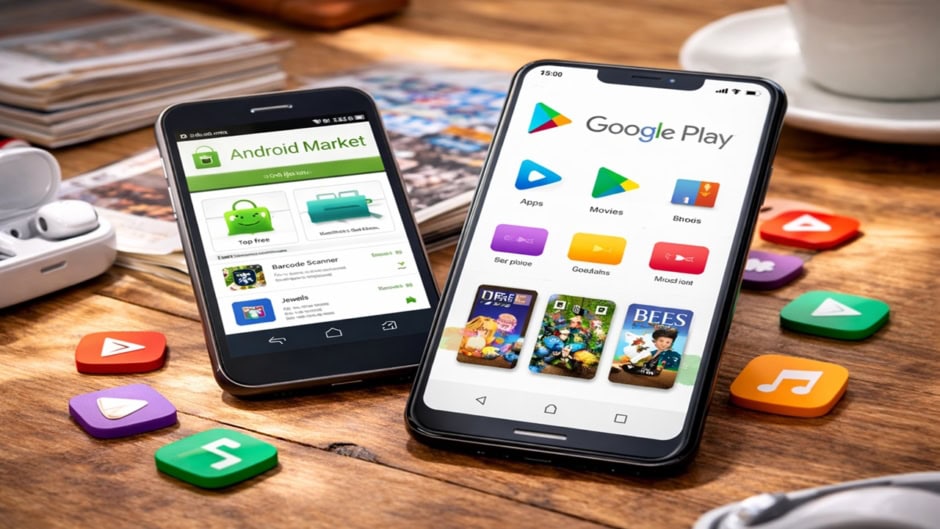
A major shift arrived in March 2012, when Google announced a sweeping reorganization of its digital services. Instead of maintaining separate platforms, the company decided to combine them into a single unified hub called Google Play.
The rebranding brought together:
- Android Market
- Google Music
- Google eBookstore
The new service offered a cloud-based platform where users could access apps, music, movies, books, and games from smartphones, tablets, or personal computers using a single Google account.
At launch, Google Play also included cloud storage for up to 20,000 songs, alongside a rapidly growing catalog of digital content. The goal was simple but ambitious: to create a unified digital store that made entertainment and applications accessible across devices.
The move also intensified competition with Apple App Store, which had already established itself as a dominant force in the mobile app industry.
Then vs Now: A Platform Transformed
In its earliest form as Android Market, the platform was limited in both scale and functionality. The number of available apps was relatively small, digital payments were restricted to a few countries, and most downloads were free. The focus was primarily on basic mobile applications and simple games.
Today, Google Play has grown into one of the largest digital distribution platforms in the world. Millions of applications are available, serving purposes that range from entertainment and gaming to education, finance, productivity, and health.
The platform now supports a complex developer ecosystem, offering tools for app development, monetization, advertising, and analytics. It also incorporates advanced features such as app security screening, user reviews, and privacy transparency tools.
In 2016, the platform expanded beyond smartphones when Google Play support was introduced to devices running ChromeOS, allowing Chromebook users to install Android apps directly on their laptops.
Later, in 2021, Google introduced a dedicated privacy information section for applications, giving users clearer insight into how apps collect and handles personal data.
Where Google Play Stands Today
More than a decade after its launch, Google Play has become a cornerstone of the Android ecosystem. The platform serves billions of users worldwide, connecting them to developers, digital creators, and entertainment providers.
For developers, it represents one of the most important gateways to a global audience. For users, it has become an everyday utility, a place to download games, manage productivity, stream movies, read books, and discover new digital experiences.
Its growth also mirrors the broader evolution of the mobile internet, where smartphones have shifted from simple communication devices to powerful platforms for work, creativity, and entertainment.