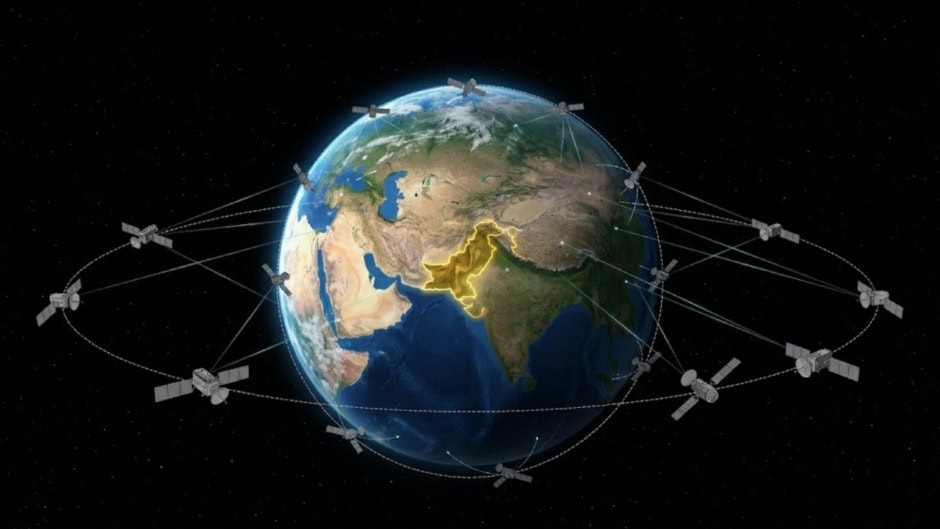
Pakistan completed its first indigenous Earth observation constellation on April 25, 2026, with SUPARCO launching the EO-3 satellite aboard China’s Long March-6 rocket from the Taiyuan Satellite Launch Centre.
EO-3 is the third and final unit of the Pakistan Remote Sensing Satellite Electro-Optical System, known as PRSC-EOS. EO-1 launched in January 2025, while EO-2 followed in February 2026. Together, the three satellites give Pakistan a functional domestic network capable of multi-temporal imaging and continuous Earth observation data collection.
EO-3 carries a Multi-Geometry Imaging Module, an advanced energy storage system, and an onboard AI-powered data processing unit that analyzes data in real time rather than relying on ground-based analysis. Experts say this significantly reduces information delays and allows government agencies to act on current conditions rather than outdated data.
Pakistan ranks among the world’s most climate-vulnerable countries by the Global Climate Risk Index. The 2022 floods caused an estimated $15.2 billion in economic losses, with agriculture alone suffering $14.9 billion in damage, according to a joint assessment by the World Bank, European Union, and Asian Development Bank.
Agriculture contributes roughly 24% to Pakistan’s GDP and employs nearly 37% of its workforce. Limited access to real-time spatial data has long constrained crop planning, irrigation management, and food security monitoring. EO-3 directly addresses that gap by enabling multi-spectral analysis of crop stress, water shortages, and groundwater utilization, while also supporting forecasting for key crops such as wheat and rice.
For disaster management, the satellite supports flood risk mapping, evacuation planning, infrastructure damage assessment, and post-disaster economic loss estimation. For urban planning, it helps authorities map unauthorized construction, monitor urban sprawl in Karachi, Lahore, and Islamabad, identify transportation and utility gaps, and track urban heat islands and air pollution.
Pakistan’s National Space Policy also aims to open the space sector to private industry, academia, and startups, with SUPARCO additionally planning an indigenous lunar rover for China’s Chang’e-8 mission.