
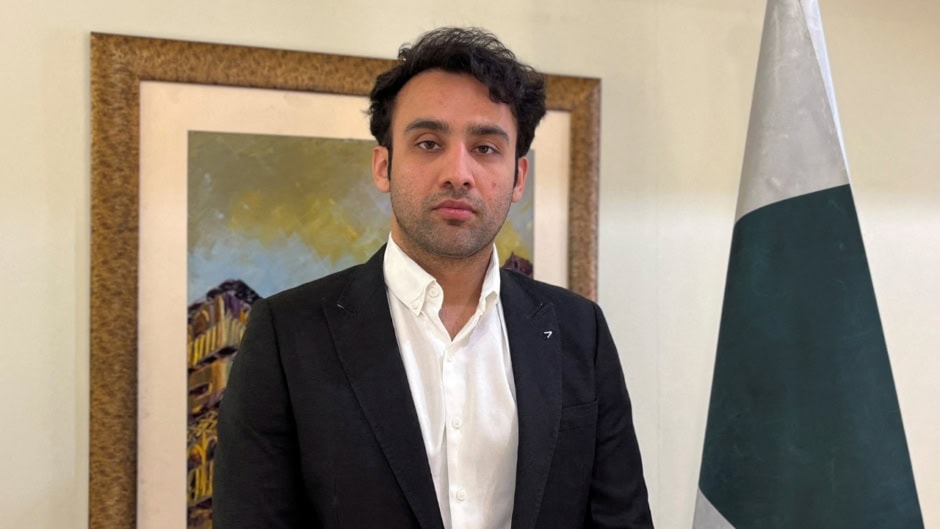
Recently, Pakistan took a massive step toward shaping the future of global finance. Minister of State and PVARA Chairman Bilal Bin Saqib briefed Prime Minister Muhammad Shehbaz Sharif and the Federal Cabinet. PVARA Chairman presented the rapid progress of Pakistan in regulating virtual assets. Furthermore, he outlined emerging opportunities in blockchain, digital assets, stablecoins, and tokenization. Major global financial institutions are already building new infrastructure. Therefore, Pakistan is actively moving to secure its place in this new economy.
Bilal Bin Saqib told the Prime Minister:
When the foundations of the modern financial order were negotiated at Bretton Woods in 1944, Pakistan did not yet exist as an independent nation.
Today, as money becomes programmable and financial infrastructure is being redesigned, Pakistan has an opportunity to participate in shaping the next generation of global finance. We must not simply rent our financial future. We must help build it.
Rapid Legislative Shifts & Milestones
Since its establishment in July 2025, Pakistan Virtual Assets Regulatory Authority (PVARA) has achieved major institutional goals. First, the authority transitioned from an initial Ordinance to the permanent Virtual Assets Act, 2026. Next, it launched a comprehensive licensing framework that covers 10 distinct virtual asset activities. Consequently, the organization moved from passing the Act to notifying licensing regulations on August 21, 2026. This entire process took roughly five months.
Moreover, the authority quickly set up regulatory gateways for major international exchanges. In December 2025, PVARA issued preliminary No Objection Certificates to Binance and HTX. Additionally, it operationalized an online application portal and a regulatory sandbox to invite global participants.
Smart Operations & SBP Collaboration
Interestingly, PVARA achieved all these milestones using less than 8% of its allocated budget. The authority relies heavily on Artificial Intelligence to power its core functions efficiently.
Meanwhile, the State Bank of Pakistan (SBP) also shifted its stance. In April 2026, the SBP officially replaced its 2018 restrictions. Instead, it introduced a conditional banking framework tailored specifically for PVARA-licensed virtual asset businesses. This new framework strictly enforces rules for governance, market conduct, cybersecurity, consumer protection, and financial integrity. Above all, it actively safeguards customer assets.
Sovereign Tokenization & Global Engagement
The new framework extends far beyond simple cryptocurrency trading. Currently, PVARA is working closely with the Ministry of Finance. Together, they are exploring sovereign debt tokenization. Specifically, they are developing proposals for digital Eurobond issuances and the tokenization of Naya Pakistan Certificates.
Internationally, Pakistan is actively stepping up. In September 2026, PVARA collaborated with Pakistan’s Permanent Mission to the UN and the UN Office for Digital and Emerging Technologies. They hosted a first-of-its-kind high-level dialogue titled “Blockchain and the Tokenized Future” during UN Digital Cooperation Day in New York. Policymakers and industry leaders discussed safeguards for next-generation financial infrastructure.
Moving forward, PVARA aims to strengthen its institutional capacity. It will enforce strict supervision, enhance coordination with existing financial regulators, and test pilots for cross-border payments. However, Saqib made his ultimate priority clear. He emphasized:
The objective is not to issue licences for the sake of announcements.
It is to build a regulator whose licences carry credibility, whose supervision protects Pakistanis, and whose framework enables responsible investment and innovation.