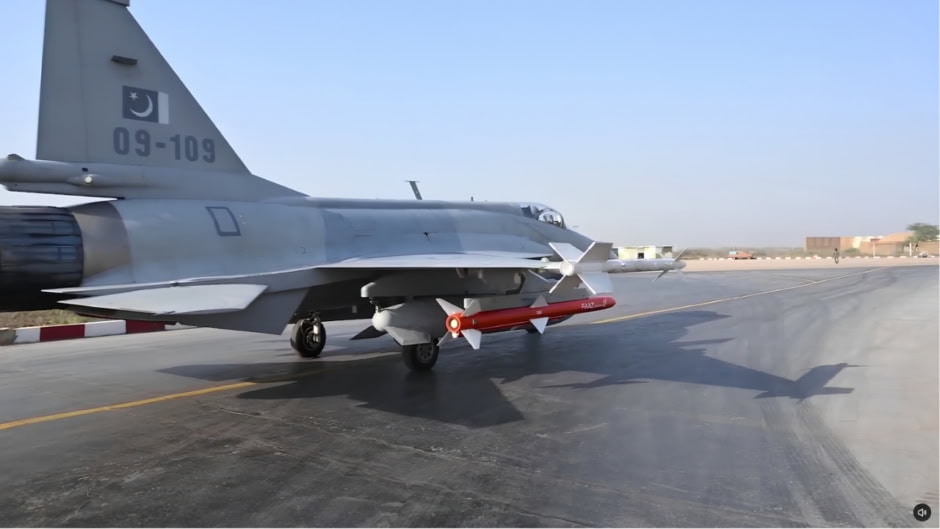
The Pakistan Air Force recently test-fired the first indigenously developed Fa’az air-to-air missile. The Directorate General of Public Relations announced this major breakthrough via a social media post on X. Consequently, this maiden flight test marks a significant milestone for national aerospace and defense capabilities. The weapon will significantly enhance the operational flexibility of the Pakistan Air Force. Ultimately, it strengthens the overall defense posture of the entire country.
PAKISTAN SUCCESSFULLY CONDUCTS FLIGHT TEST OF FIRST INDIGENOUSLY DEVELOPED FA’AZ AIR- TO-AIR MISSILE
Pakistan has conducted successful flight test of first indigenously developed Fa’az air- to-air missile, marking another significant milestone in the advancement of national aerospace and defense capabilities. Equipped with state of the art terminal guidance system, it can engage enemy aerial targets at longer ranges. Fa’az will significantly enhance operational flexibility of Pakistan Air Force, further strengthening the country’s overall defense posture. The successful flight test underscores the technical maturity, innovation and self reliance achieved by Pakistan’s defense industry.
The launch was witnessed by senior officers of the Pakistan Armed Forces, along with distinguished scientists and engineers who played a pivotal role in the development of this advanced weapon system.
The President, Prime Minister of Pakistan, COAS & CDF and Services Chiefs have congratulated the scientists and engineers on this remarkable achievement.
— DGPR (AIR FORCE) (@DGPR_PAF) November 3, 2026
Fa’az Air-to-Air Missile Specifications & Launch Platform
During the test, a JF-17 Thunder Block-1 fired the Fa’az missile from an underwing weapons pylon. This specific aircraft underwent a major overhaul at the Pakistan Aeronautical Complex (PAC) starting in 2019. Global Industrial and Defence Solutions officially revealed the Fa’az platform to the public in 2023. Furthermore, NESCOM’s Air Weapons Complex completely developed this munition. This exact same complex previously created the Ra’ad and Taimur air-launched cruise missiles.
Engineers equipped the tested Fa’az version with a state-of-the-art terminal guidance system. Specifically, the missile utilizes an imaging infrared seeker featuring a detection range of 40 to 45 kilometers. Alternatively, forces can configure the weapon with an active radar-homing seeker that offers a 25-kilometer detection range. Therefore, the missile can effectively engage enemy aerial targets at much longer ranges.
Regional Security & Recent Military Conflicts
This development arrives amid evolving regional security challenges. Over a year ago, Pakistan and India engaged in a brief but intense military conflict. The nuclear-armed neighbors exchanged fierce artillery and missile fire. During the clashes, both nations heavily deployed fighter jets and combat drones. Subsequently, Pakistan shot down six Indian aircraft. This impressive tally notably included a highly advanced French-made Rafale fighter jet. Meanwhile, India officially denied losing six aircraft but firmly acknowledged suffering some aerial losses.
Pakistan aggressively continues to modernize its military capabilities through indigenous development. Earlier this month, the Pakistan Army successfully test-fired the extended-range version of its Fatah-2 hypersonic ballistic missile. This advanced weapon utilizes advanced navigation and a unique trajectory to defeat enemy missile defense systems. A week prior to that launch, forces also tested an extended version of the Fatah-4 ground-launched cruise missile. Previously, the military conducted a successful training launch of the original Fatah-4 at a 750-kilometer range in September 2025. These consecutive tests continuously validate critical navigational subsystems and drastically improve overall survivability.
National Leadership Applauds Technical Maturity
Senior officers from the Pakistan Armed Forces personally witnessed the maiden Fa’az flight test. Distinguished scientists and engineers also attended the historic launch event. Following the successful test, the Inter-Services Public Relations issued an official statement. The military media wing proudly declared that the flight demonstrated the technical maturity, innovation, and self-reliance of the national defense industry. Consequently, top state officials praised the engineering teams. The President, Prime Minister, Chief of Army Staff, and Chief of Defence Forces all extended their congratulations. Additionally, Interior Minister Mohsin Naqvi commended the scientists for achieving this remarkable and historic national milestone.