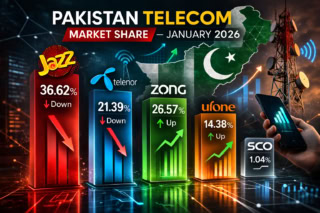
Pakistan’s mobile market added more than two million new users in just one month, according to fresh data released by the Pakistan Telecommunication Authority. The numbers show steady growth across cellular subscriptions and next-generation services as operators push deeper into 4G.
The country’s total cellular subscriber base rose from 200.55 million at the end of December 2025 to 202.575 million by the end of January 2026. This increase highlights continued demand for mobile connectivity across urban and rural areas.
Teledensity also moved up during the same period. Mobile teledensity, which tracks the number of mobile connections per 100 people, increased from 80 percent in December 2025 to 81 percent by the end of January. Meanwhile, overall teledensity climbed from 81.33 percent to 82 percent in January 2026.
At the same time, data usage continued to expand. The total number of 3G and 4G users grew from 150.588 million in December to 153.325 million in January. This marks a net addition of over 2.737 million users in just one month. As a result, the Next Generation Mobile Service penetration rate improved from 60.32 percent to 61.32 percent, showing steady adoption of faster mobile internet.
A closer look at individual operators reveals mixed trends. Jazz maintained zero users on 3G. However, its 4G base increased from 55.528 million at the end of December to 55.979 million in January.
Zong also expanded its 4G footprint. Its 4G subscriptions rose from 42.35 million to 43.065 million over the month. However, its 3G users declined from 1.654 million to 1.622 million.
Telenor Pakistan saw a sharper drop in 3G subscribers, which fell from 0.888 million to 0.622 million. In contrast, its 4G customer base grew from 27.42 million in December to 28.75 million in January.
Ufone followed a similar pattern. Its 3G users declined slightly from 1.073 million to 1.058 million. Meanwhile, its 4G subscribers increased from 19.708 million to 20.252 million.
Overall, the data shows that Pakistan’s telecom sector continues to shift away from 3G while strengthening its 4G networks. The latest figures suggest that users are moving quickly toward faster data services, even as traditional mobile growth remains steady.