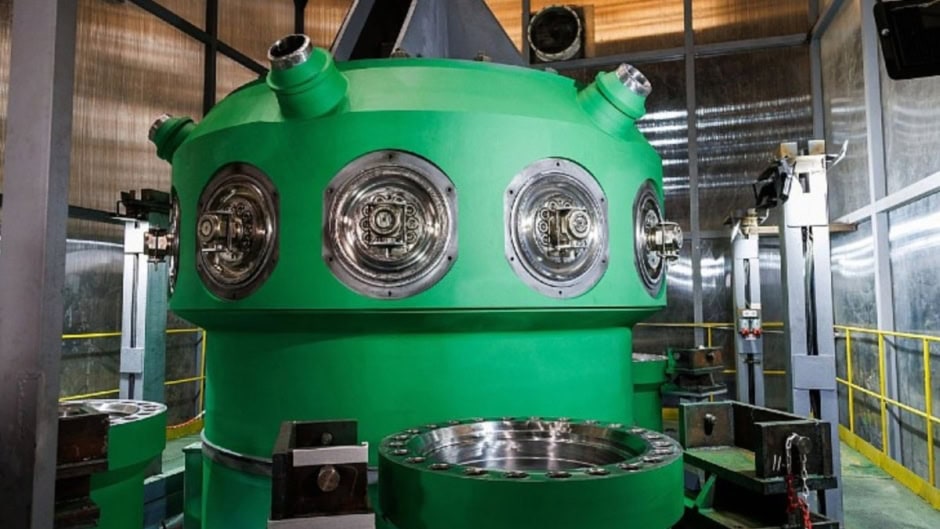
Russia has officially launched its advanced RITM-400 nuclear reactor, which is designed to power the upcoming ‘Rossiya’ icebreaker, set to become the world’s most powerful nuclear-powered vessel for Arctic missions.
Developed by ZiO-Podolsk, a unit of Rosatom’s Machine-Building Division, the RITM-400 nuclear reactor is a high-capacity upgrade to the RITM-200 model. It delivers 315 megawatts of thermal power and 120 megawatts of shaft power, ensuring unmatched performance in navigating the Arctic’s toughest ice conditions.
During the unveiling ceremony, Rosatom Director General Alexey Likhachev underscored the significance of the milestone. “The completion of the RITM-400 reactor is a notable achievement for Rosatom, the icebreaker fleet, and the entire nation,” he said.
He also announced that the twin reactors destined for the ‘Rossiya’ vessel will carry the names of Russian folklore heroes, Ilya Muromets and Dobrynya Nikitich, as symbols of strength and resilience.
“These reactors will empower the Rossiya icebreaker to tackle the harsh Arctic environment, living up to the legacy of their legendary namesakes,” Likhachev added in a press release.
Rosatom’s Machine Building Division Head, Igor Kotov, confirmed that the second reactor unit will be completed within a few months. Both reactors will then be installed on the Rossiya ship, aligning with the 80th anniversary of Russia’s nuclear industry. “This marks a major step in strengthening the Northern Sea Route,” he noted.
Once fitted with two RITM-400 reactors, the Rossiya will be capable of breaking through ice up to 4.3 meters (14 feet) thick and clearing passages 50 meters (164 feet) wide. It is the flagship vessel under Project 10510, with operations expected to begin by 2030.
Russian Investment in Nuclear Icebreakers
Russia’s strategic investment in nuclear icebreakers is driven by the need to secure and expand access to the Northern Sea Route. Unlike diesel-powered ships, nuclear icebreakers offer extended range, higher power, and years of operation without refuelling—crucial advantages for remote Arctic operations.
Currently, construction is underway on three nuclear icebreakers—Chukotka, Leningrad, and Rossiya—with a fourth vessel, Stalingrad, in the pipeline under Project 22220. Moscow also plans to expand its fleet further to ensure uninterrupted navigation along the 5,600-kilometre (3,479-mile) Northern Sea Route.
This Arctic corridor slashes travel time dramatically. Russia claims the route can reduce the shipping duration from Murmansk to Japanese ports from 37 days via the Suez Canal to just 18 days.
As global shipping intensifies and climate change reshapes Arctic accessibility, Russia’s deployment of the RITM-400 nuclear reactor signifies both technological prowess and strategic foresight in asserting dominance over the polar passage.