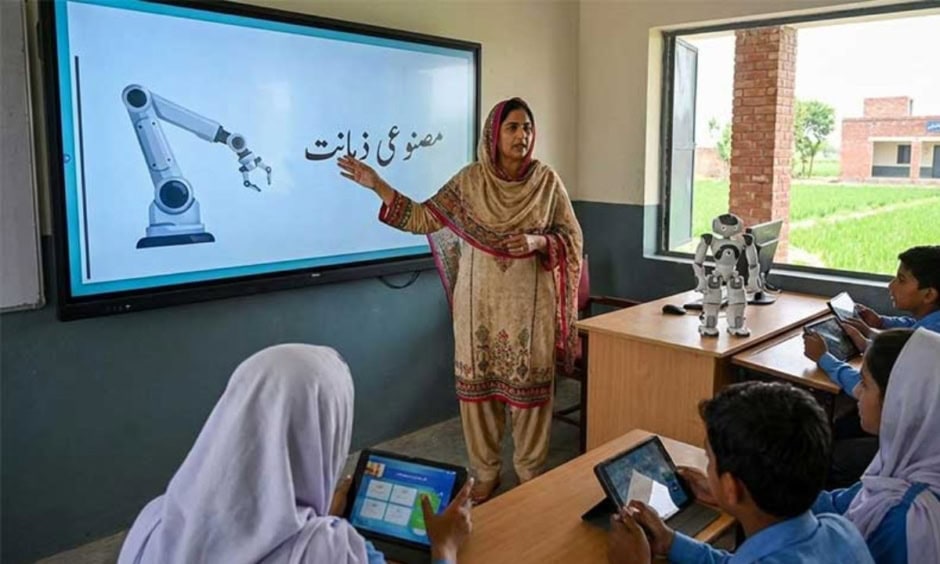
Punjab has launched a new artificial intelligence (AI) curriculum, aiming to equip students with essential digital skills and prepare them for the demands of the modern technological era.

The Punjab Education, Curriculum, Training and Assessment Authority (PECTAA) said the initiative aligns with the timeline set by Chief Minister Maryam Nawaz, ensuring early integration of digital education.
Chief Executive Officer Muhammad Musa Ali Bokhari presented the first draft of the curriculum to the provincial education minister and the parliamentary secretary.
The curriculum covers computing basics, data science, machine learning, robotics, and ethical artificial intelligence, structured progressively to match age levels and student learning capacity.
PECTAA stated the framework incorporates international standards while addressing local needs, emphasizing ethics, governance, creativity, problem-solving, and responsible digital citizenship.
The authority highlighted that the initiative is designed to move students beyond basic technology use, encouraging innovation, practical application, and adaptation to evolving digital challenges.
Earlier this year, the elementary and secondary education department in KP revised computer science curricula, incorporating artificial intelligence courses from grades six to twelve.
Officials stated the department required Rs7.25 billion for new computer labs, teacher recruitment, IT capacity building, infrastructure strengthening, and establishing online artificial intelligence.
A summary requesting approval of funds was submitted to the chief minister, covering operationalisation of 325 non-functional IT labs and internet connectivity for 958 schools.
From grades six to eight, student learning outcomes lacked fundamental artificial intelligence concepts, prompting integration of essential knowledge, skills, and introduction of a new AI domain.
For grades nine to twelve, AI concepts already existed but required strengthening, leading to expanded competencies, improved clarity, and alignment with contemporary technological developments.
Officials confirmed 10,605 teachers are required for IT subjects province-wide, but only 3,050 are currently available, leaving a shortfall of 7,555 across all school levels.