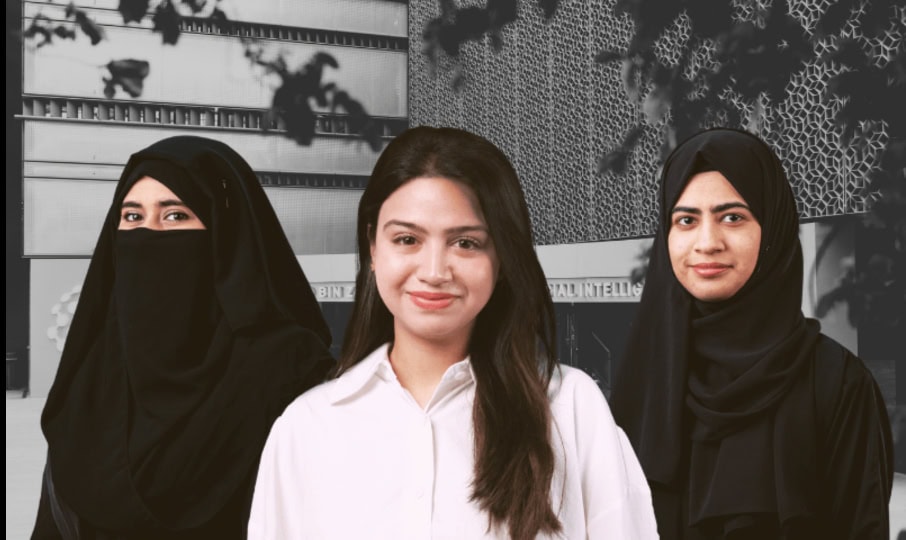
Artificial intelligence is rapidly transforming the globe, and three Pakistani women graduating from Mohamed bin Zayed University of Artificial Intelligence (MBZUAI) in Abu Dhabi are doing wonders. They have developed AI tools to enhance accessibility in healthcare and education.

Breaking Language Barriers in AI
AI is a crucial part of our lives, but sometimes we find these AI models struggling with understanding our local language. To solve this issue, Ashba Sameed, 27, an AI researcher from Karachi, has focused her work at MBZUAI on improving how AI understands and connects spoken language with written text.
Her research evaluated advanced AI models (Spirit LM and Mini-Omni) on tasks like summarization, question answering, and translating speech and text in multiple languages, including Arabic and English. Spirit LM excelled in emotional understanding, while Mini-Omni performed better in instruction-based tasks. Sameed’s work is particularly relevant for Pakistan, where many people speak regional languages and may have limited access to text-based technology.
By making voice-based AI systems smarter and more multilingual, her research can lead to the development of user-friendly tools such as voice assistants, automated helplines, and translation apps. This could significantly improve access to education, healthcare, and government services for individuals who are not fluent in English or cannot read.
AI for Accessible Healthcare
Another student is, Tooba Tehreem Sheikh. Driven by a personal tragedy of losing her mother to a late-stage colon cancer diagnosis in 2007, she dedicated her work to early medical problem detection using AI. Graduating with a master’s in computer vision from MBZUAI, her research focuses on real-time AI systems for medical imaging. It aims to enable faster and more accurate diagnoses, particularly in resource-limited settings like Pakistan.
Sheikh developed two models: IHA-YOLO and Med-YOLOworld. IHA-YOLO is a lightweight, real-time cell detection system, while Med-YOLOWorld is an open-vocabulary detection system capable of working across nine medical imaging modalities. The lightweight nature of these systems means they can operate on existing equipment in many Pakistani hospitals, eliminating the need for expensive and high-end computational resources.
These models process medical images such as CT scans, X-rays, MRIs, and colonoscopy footage to identify organs and potential diseases. While IHA-YOLO effectively detects known categories, Med-YOLOWorld can identify novel anomalies it wasn’t explicitly trained on. Sheikh emphasizes that her work aims to aid diagnoses, not replace human expertise. Sheikh plans to return to Pakistan to establish a hospital integrating AI into diagnostic care, acknowledging the country’s need for healthcare digitization.
Education For All Through Scigrade
Fatimah Lyba Khan, 26, pursued natural language processing at MBZUAI, where she built SciGrade. SciGrade is a dataset and AI system designed to simplify complex scientific texts across five educational levels and ten disciplines, including biology, chemistry, physics, ecology, and meteorology.
SciGrade utilizes large language models (LLMs) to simplify scientific content for various grade bands, from Grade 1 to college level. Khan’s innovative approach ensures that while simplifying the language, the tool also adapts the tone, vocabulary, and sentence structure for each target audience. She achieves this by designing specific prompts for each grade level and rigorously testing outputs.
Currently functioning in English, Khan intends to expand SciGrade’s capabilities to other languages like Arabic. For countries like Pakistan, where access to formal education might be limited, a tool like SciGrade could be instrumental in translating technical information into easily digestible content.